The Lifecycle of Wood
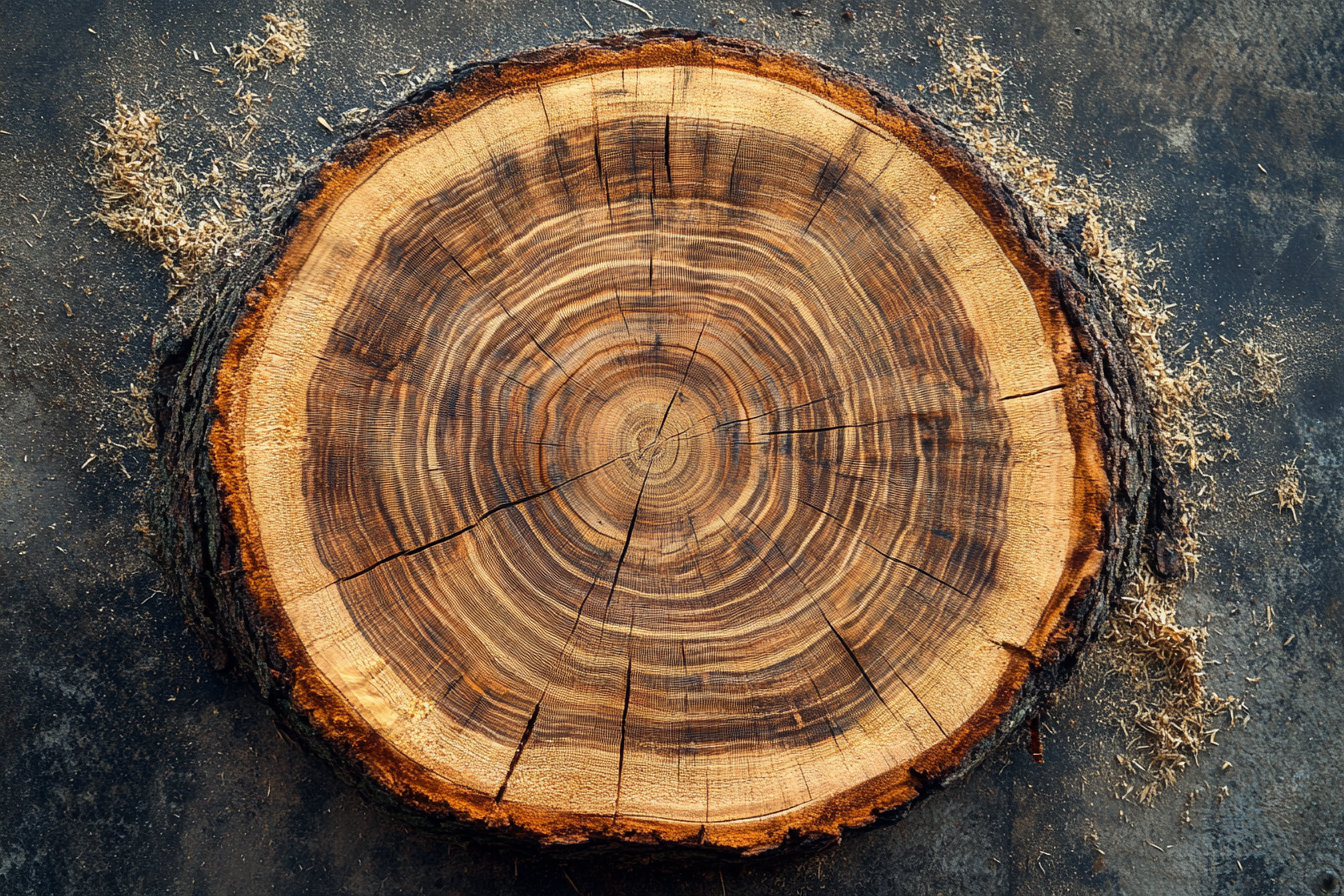
Wood is the only structural building material that was once alive. It grew according to its conditions — faster in warm, wet years; slower in drought — and the record of that growth is legible in every cross-section: the width of the annual rings, the density of latewood, the proportion of heartwood to sapwood. A timber beam is not an inert product. It is a biological record, fixed at the moment of felling, that continues to respond to its environment — absorbing and releasing moisture, shrinking and swelling across the grain, aging under ultraviolet light — for as long as it remains in service.
A cubic meter of timber contains approximately 250 kilograms of carbon, drawn from atmospheric carbon dioxide during the tree's growth and stored in the cellulose, hemicellulose, and lignin that form the cell walls. This carbon remains locked in the wood for as long as the wood persists. A building framed in timber is, in this sense, a carbon store — not because it was designed to be, but because the material it is made from happens to be composed of sequestered atmospheric carbon. When the wood decays or burns, the carbon returns to the atmosphere. The duration of storage depends entirely on what happens to the wood after felling.
Moisture and Movement
A living tree contains water in two forms: free water filling the cell cavities, and bound water held within the cell walls. The moisture content of freshly felled timber varies by species and season but typically ranges from 40 to over 100 percent — that is, the weight of water in the wood may equal or exceed the weight of the wood substance itself. As the timber dries, the free water evaporates first, with no dimensional change. When the moisture content drops below approximately 28 to 30 percent — the fiber saturation point — the bound water begins to leave the cell walls, and the wood shrinks.
The shrinkage is anisotropic. Tangentially — around the growth rings — wood shrinks roughly twice as much as radially — across the rings — and negligibly along the grain. This differential movement is the source of nearly every distortion in timber: cupping, bowing, twisting, and checking. A squared timber cut from a round log cannot dry without distortion, because the tangential and radial shrinkage rates differ and the growth rings curve through the section. Quarter-sawn boards, with the rings running roughly perpendicular to the face, move less across their width than flat-sawn boards. This has been understood for centuries. The choice of sawing pattern is a choice about how the wood will behave over time.
Air-dried timber reaches an equilibrium moisture content of approximately 12 to 18 percent, depending on the ambient humidity of its environment. Kiln-dried timber is brought to 6 to 12 percent. In service, wood continuously adjusts to its surroundings — absorbing moisture in humid conditions, releasing it in dry ones — and this cyclical movement continues for the life of the member. The movement is small in well-seasoned timber — a few millimeters across a wide board — but it is never zero. Wood is never still.
Heartwood and Durability
As a tree grows, the inner sapwood — the living tissue that conducts water and stores nutrients — gradually transforms into heartwood. The cells die, the water-conducting pathways are blocked by tyloses or aspirated pits, and extractive compounds — tannins, resins, oils, and phenolics — accumulate in the cell walls. These extractives are what give heartwood its characteristic color, its resistance to decay, and its distinctive scent. Oak heartwood is brown because of tannins. Cedar heartwood is aromatic because of thujaplicins. Larch heartwood is dense with resin.
The natural durability of timber varies enormously by species and depends almost entirely on the heartwood. Sapwood of all species is susceptible to decay — it retains the sugars and starches that fungi feed on and lacks the protective extractives that heartwood contains. The durability classification used in European standards ranges from Class 1 (very durable — service life exceeding 25 years in ground contact) to Class 5 (not durable — less than 5 years in ground contact). Oak, sweet chestnut, and black locust are Class 1 or 2. Western red cedar and European larch are Class 3. Douglas fir heartwood is Class 3 to 4. Spruce, pine, and most softwoods are Class 4 or 5 — they will decay rapidly if exposed to sustained moisture without chemical treatment.
Chemical preservative treatment extends the service life of non-durable species by introducing fungicidal and insecticidal compounds into the wood — typically by pressure impregnation. Copper-based treatments are the current standard for exterior use, having replaced the chromated copper arsenate formulations that were phased out for most general applications. The treatment penetrates sapwood readily but heartwood poorly, because the same cellular structures that block water in heartwood also resist preservative uptake. A pressure-treated timber is, in practice, a treated sapwood shell around an untreated heartwood core.
Decay
Wood decay is a biological process — fungi decompose the cellulose, hemicellulose, and lignin that form the cell walls, converting them to carbon dioxide and water. The process requires four conditions simultaneously: moisture content above approximately 20 percent, oxygen, moderate temperature (5 to 40 degrees Celsius, optimal around 25), and the presence of fungal spores or hyphae. Remove any one of these conditions and decay stops. This is why submerged timber — pilings driven below the water table, bog oak preserved in anaerobic peat — can survive for centuries or millennia. The wood is wet, but without oxygen the fungi cannot metabolize.
In buildings, decay occurs where water accumulates and cannot dry: at the base of posts in contact with soil, at beam ends embedded in damp masonry, at joints where rainwater collects and ventilation is restricted. The pattern is consistent and predictable. Sound timber does not decay randomly. It decays at the points where moisture management has failed — where a flashing was omitted, a drip groove neglected, a ventilation path blocked, or a detail allowed water to be held rather than shed. Decay in a timber building is diagnostic. It identifies exactly where the building's defenses were breached.
Engineered Wood
The limitations of solid timber — its size is constrained by the tree, its strength is reduced by natural defects, its dimensional stability is limited by its response to moisture — are addressed by engineered wood products that reconstitute the material into forms that the tree could not provide. Cross-laminated timber panels laminate layers of boards at right angles, producing flat elements that are dimensionally stable, strong in both directions, and available in sizes limited only by transport rather than by tree diameter. Glued laminated timber bonds layers of graded boards into beams and columns that can span further and carry greater loads than any single piece of sawn timber. Laminated veneer lumber peels thin veneers from logs and glues them into structural members with predictable, consistent properties.
These products extend what timber can do structurally — allowing multi-story timber buildings, long-span roofs, and load-bearing panels that compete with steel and concrete for structural applications. They also change the material's relationship with time. A cross-laminated panel, with its alternating grain directions, moves far less in response to moisture changes than a solid board of the same width. The cross-lamination constrains the movement that the wood would otherwise express. The material is still wood — still hygroscopic, still combustible, still composed of sequestered carbon — but its behavior has been redesigned.
What Remains
The oldest surviving timber structures — the stave churches of Norway, the temple frameworks of Japan, the cruck barns of England — have been maintained continuously for five hundred to a thousand years. The wood in these buildings has been kept dry, kept ventilated, and repaired or replaced at individual members as decay or damage required. The structure persists not because the wood is indestructible but because each piece that failed was identified and replaced before the failure propagated. The building is maintained as an assembly, not as a material.
Wood that is protected from moisture and ultraviolet exposure remains structurally sound indefinitely. The cellulose does not degrade in dry conditions. The lignin does not weaken. The fibers do not fatigue under static loads, though they creep slowly under sustained stress — a deflection that develops over years and decades, measurable but rarely structural. A dry timber beam in a well-maintained building is functionally the same at three hundred years as it was at thirty. The carbon it absorbed as a tree remains stored. The record of its growth rings remains legible. The material waits, as it always has, for either water or fire to return it to the cycle from which it came.