Stone in Architecture
Stone is the geology of a place made vertical. A limestone wall is the compressed sediment of an ancient seabed, cut and stacked and set in mortar, now standing in air and carrying load. The material remembers its formation — in its bedding planes, its fossil inclusions, its response to water — and these memories determine how it performs as a building material, centuries after it was quarried.
The fundamental property of stone in construction is its compressive strength. Stone resists crushing loads with an authority that few materials can match: granite at 130 to 250 megapascals, limestone at 20 to 170 depending on density, sandstone at 20 to 170 depending on cementation. These numbers describe a material that is supremely suited to walls, columns, foundations, and any application where the load path is downward. In tension, stone is weak — it cracks, cleanly and without warning. This asymmetry governs every decision about how stone is used. Arches, vaults, buttresses: the entire vocabulary of stone architecture exists to keep the material in compression, routing tensile forces around it or eliminating them through geometry.
The second property of consequence is thermal mass. A 400-millimeter stone wall absorbs heat slowly, stores it in considerable quantity, and releases it over a period of eight to twelve hours. In climates with significant diurnal temperature variation, this produces an interior that is cooler than the exterior during the day and warmer at night — a passive modulation that requires no energy input and no mechanical system. The wall simply does what its physics dictate, and the result is habitable.
Types and Their Character
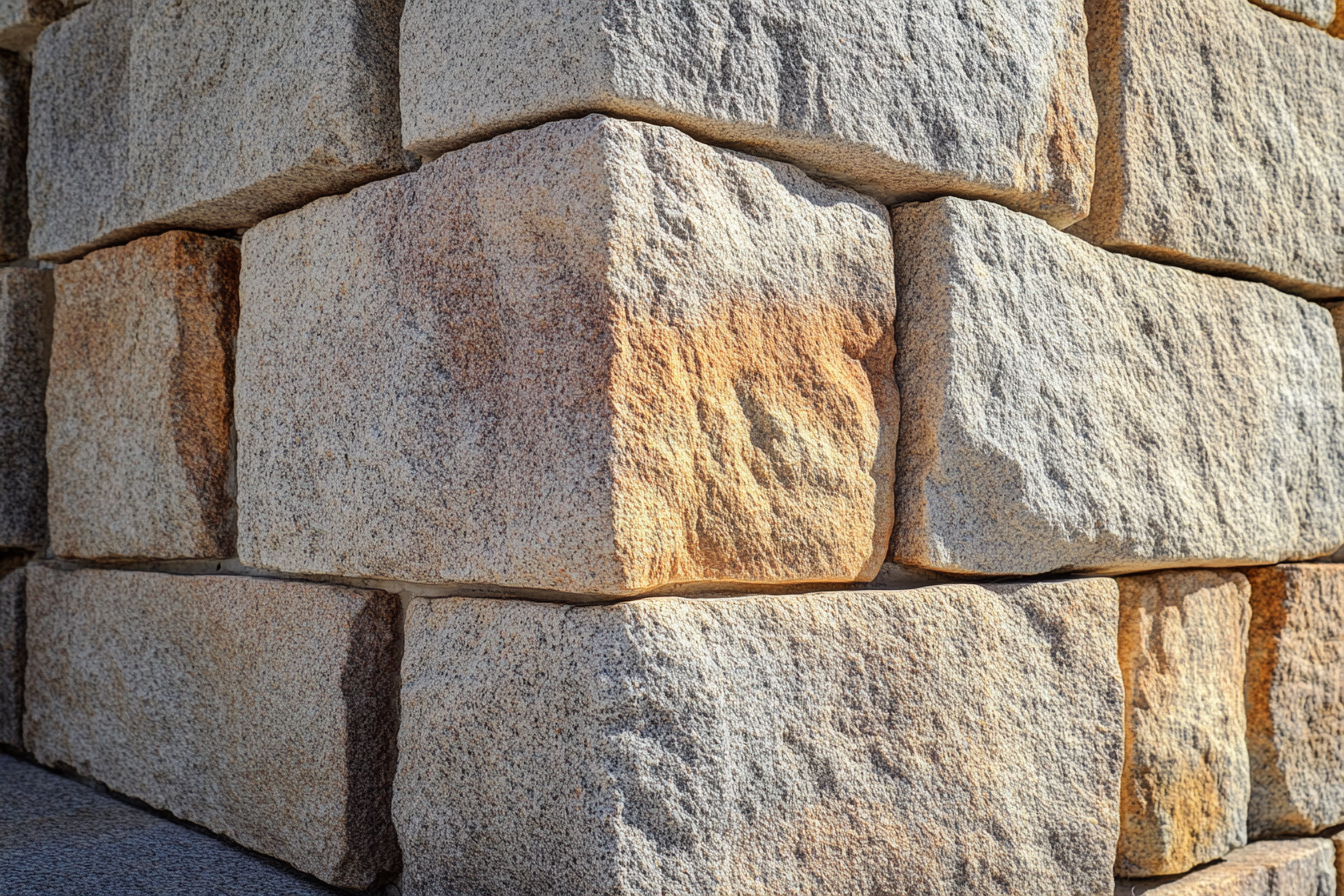
Each stone type carries the signature of its geological origin, and this signature determines its architectural behavior. Granite is igneous — formed from cooled magma, crystalline in structure, extremely hard, and resistant to weathering. It is difficult to cut and shape, which historically limited its use to foundations, plinths, and locations where durability under exposure justified the effort. Its surface, once dressed, holds its profile indefinitely.
Limestone is sedimentary — layers of calcium carbonate deposited over millions of years, compressed into rock. It is softer than granite, easier to work, and available in a range of densities from the porous oolitic limestones that can be sawn with a hand saw to the dense carboniferous limestones that approach granite in hardness. Limestone weathers by dissolution: rainwater, mildly acidic from dissolved carbon dioxide, slowly dissolves the surface, rounding edges and softening carved detail over decades and centuries. The weathering is visible and beautiful — a kind of geological erosion played out at architectural speed.
Sandstone is sedimentary as well, but its particles are silica grains cemented with various minerals. The strength and durability of sandstone depend almost entirely on the cemite: silica-cemented sandstones are hard and weather-resistant; clay-cemented sandstones are soft and vulnerable to freeze-thaw damage. Choosing the wrong sandstone for an exposed location is a consequential error — the stone may delaminate along its bedding planes within decades, shedding its face in sheets. Choosing correctly, and laying it on its natural bed, produces a wall that endures.
Slate is metamorphic — shale transformed by heat and pressure into a dense, fine-grained rock that cleaves naturally into thin, flat sheets. This cleavage makes slate uniquely suited to roofing and floor paving, where thin sections are advantageous. A slate roof, properly laid with adequate headlap and fixed with copper or stainless steel nails, has a service life measured in centuries. The material does not degrade under UV exposure, does not become brittle with age, and does not absorb significant moisture. It simply sits on the roof and sheds water, for as long as the structure beneath it stands.
Working Stone
The craft of stonework is governed by the bedding plane. Sedimentary stones — limestone, sandstone — have a natural orientation corresponding to the layers in which they were deposited. When set in a wall with the bedding planes horizontal, the stone performs as it did in the ground: the weight of the wall compresses the layers together, and moisture drains across the face rather than wicking into the joints between layers. When set with the bedding planes vertical — face-bedded — the stone is vulnerable. Water enters the exposed layer boundaries, freezes, expands, and levers the face off the wall. The stone itself is unchanged; the orientation is everything.
Stone is cut to dimension by sawing, splitting along natural planes, or dressing with hand tools — point, chisel, and bush hammer, each producing a different surface texture. The tooling affects not just appearance but weathering behavior: a rough-pointed surface sheds water quickly but collects dirt in its recesses; a smooth-rubbed surface sheds dirt but may hold a thin film of water that accelerates dissolution. The choice is made with the exposure in mind — sheltered surfaces can be finely dressed; exposed surfaces benefit from a coarser texture that encourages rapid drainage.
Mortar and Movement
The mortar in a stone wall is not a adhesive. It is a cushion — a compliant layer between rigid units that distributes load evenly across the bearing surfaces and accommodates the slight dimensional variations that natural stone inevitably carries. The mortar must be softer than the stone, so that any movement in the wall is absorbed by the mortar joints rather than transmitted as stress to the masonry units. Lime mortar meets this requirement. Cement mortar, in most cases, does not — it is harder than many building stones, and the result of using it is cracking of the stone rather than the joint.
A well-built stone wall is not rigid. It flexes — imperceptibly, but measurably — with temperature, with wind load, with the seasonal expansion and contraction of the ground beneath its foundation. The lime mortar joints absorb this movement, cracking microscopically and healing through carbonation as dissolved lime migrates into the cracks and re-solidifies. The wall is a system, not a monolith, and its longevity depends on the joints remaining the weakest element — sacrificial, repairable, and renewable on a cycle of decades rather than centuries.
Permanence and Its Conditions
Stone is the most durable common building material. This is a statement about geology, not about buildings. The stone itself will outlast any structure it is placed in — the question is whether the structure is designed to let the stone do what it does well and protect it from what it does poorly. A granite plinth on a well-drained foundation will stand for millennia. A sandstone cornice exposed to driving rain and freeze-thaw cycles without adequate drip detailing may fail within a century. The material is the same in both cases. The detailing is not.
The buildings that demonstrate stone's full potential are those where the detailing is as carefully considered as the material selection: adequate overhangs to protect the wall face, drip courses to prevent water from running down vertical surfaces, through-stone drainage to carry moisture out of the core, and lime mortar that can be re-pointed on a regular cycle without damaging the masonry. These are not improvements on the stone. They are the conditions under which the stone's inherent durability is allowed to express itself. The material provides the permanence. The building must provide the context.