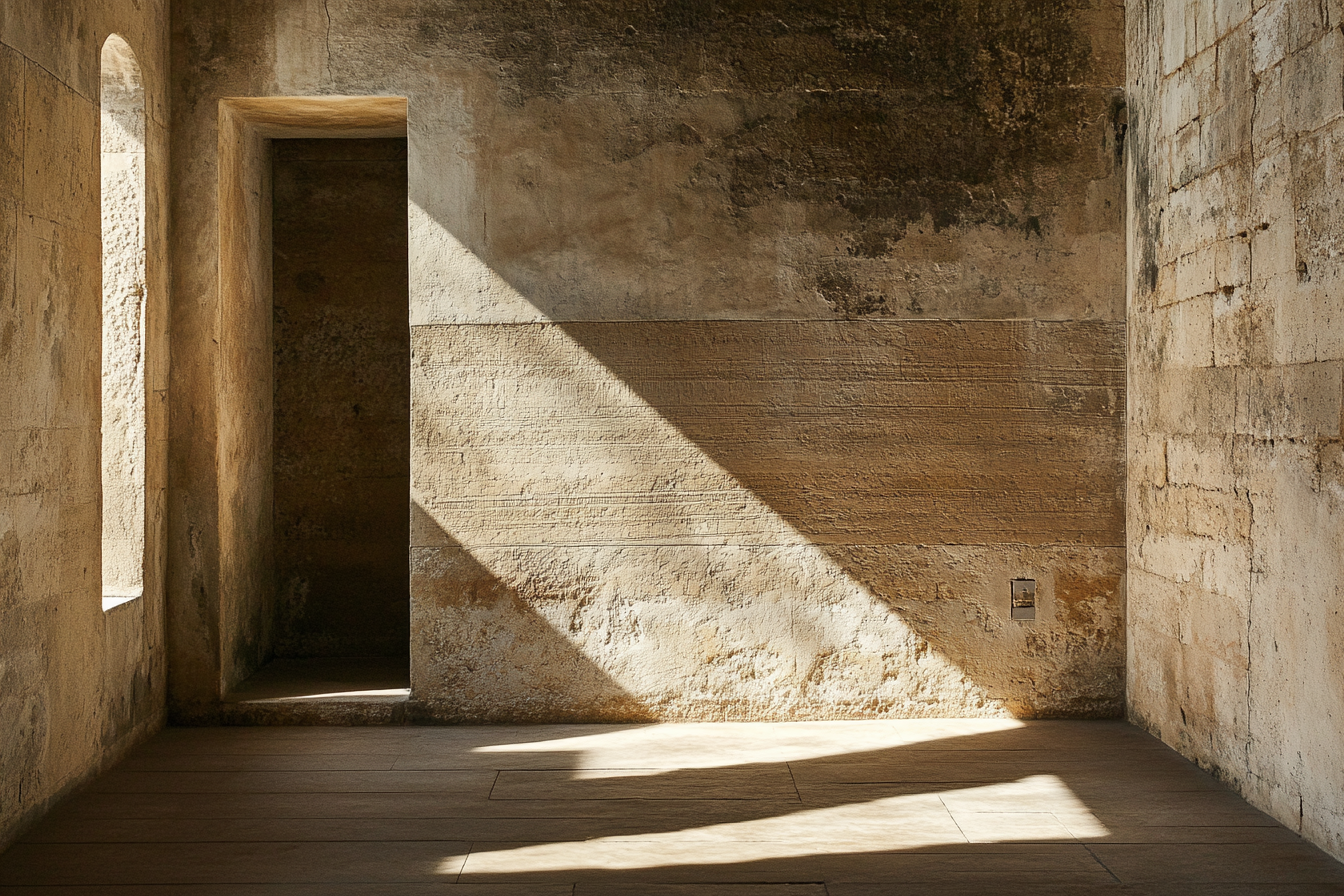
The Science of Thermal Mass
A heavy wall does not keep heat out. It keeps heat waiting. The distinction matters more than most building discussions acknowledge, and understanding it changes how one thinks about materials, climate, and the relationship between a building and the day.
Thermal mass is the capacity of a material to absorb thermal energy, store it, and release it later. Every material has this property to some degree; what varies is the quantity of energy a given volume can hold and the rate at which it moves through the material. These two properties — specific heat capacity and thermal conductivity — combine to determine the thermal lag: the delay between when heat arrives at one surface and when it reaches the other.
This delay is the entire point. In a building with high thermal mass, the peak temperature of the exterior surface does not translate into a peak temperature on the interior at the same time. It arrives hours later, often six to twelve hours later in thick concrete or earth walls. If the exterior temperature cycle is roughly symmetrical — hot midday, cool midnight — then the heat from noon arrives inside at midnight, when it is welcome, and the cool of midnight arrives inside at noon, when it is useful. The building is running on yesterday's weather, and the result is an interior climate that is substantially more stable than the exterior.
What Thermal Mass Is Not
Thermal mass is frequently confused with insulation, and the confusion leads to poor decisions. Insulation resists heat transfer — it slows the rate at which energy passes through a material, measured as thermal resistance or R-value. A well-insulated wall reduces total heat flow regardless of time of day. Thermal mass does not reduce total heat flow; it redistributes it across time.
The practical consequence is that thermal mass is effective only in climates where the redistribution is useful — where the daily temperature swings through a range that brackets the desired interior temperature. In a desert climate with 40-degree days and 10-degree nights, a massive wall delivers heat to the interior during the cold hours and absorbs it during the hot ones. In a climate that is continuously cold or continuously hot, without significant swing, thermal mass alone accomplishes little. It stores energy that is never needed, or releases energy when the building is already warm. In such climates, insulation is the correct strategy, and mass serves only as structural material.
The most effective envelope designs in temperate and cold climates combine both: mass on the interior, insulation on the exterior. The mass moderates interior temperature swings from internal heat sources and solar gain, while the insulation reduces total heat loss to the exterior. This is not a compromise — it is the application of each principle where it performs best.
Materials Compared
The relevant property for thermal mass is volumetric heat capacity: the amount of energy a cubic meter of material can absorb for each degree of temperature rise. Water is the reference standard at approximately 4,180 kilojoules per cubic meter per degree Celsius. Concrete is roughly 2,000. Rammed earth is similar, varying with density and moisture content. Stone depends on type: granite is approximately 2,400, sandstone around 1,800, limestone between the two. Brick is approximately 1,360. Timber is around 900 — low enough that wood-framed buildings have negligible thermal mass unless deliberately supplemented.
But volumetric heat capacity is only half the equation. Thermal conductivity determines how quickly the stored heat moves through the material. A material with high capacity but low conductivity absorbs heat slowly and releases it slowly — a long lag. A material with high capacity and high conductivity absorbs and releases quickly — a short lag. For buildings, a long lag is generally desirable: it extends the time shift and increases the damping effect on the temperature cycle. Dense concrete and stone, with moderate conductivity and high capacity, produce the lags most useful for building applications — typically four to twelve hours depending on wall thickness.
Thickness and Diminishing Returns
There is a practical limit to useful thermal mass, and it is determined by the wall thickness relative to the diurnal cycle. A wall that is too thin allows heat to pass through before the cycle reverses — the lag is shorter than the half-day needed for effective modulation. A wall that is too thick stores heat that never reaches the interior at all during the relevant cycle — the outer portion of the wall participates in the daily exchange, but the deep interior remains at a stable average temperature and contributes nothing to the daily moderation.
For most materials and climates, the effective thermal mass depth is between 100 and 200 millimeters from the interior surface. Beyond that depth, additional mass adds structural weight without proportional thermal benefit. This has design implications: a 600-millimeter rammed earth wall is structurally impressive but thermally redundant beyond the inner third. The outer two-thirds participate in longer cycles — weekly or seasonal — but their contribution to daily comfort is marginal. The wall does not know this, of course. It simply absorbs and releases heat at the rate its physics dictate, indifferent to whether anyone finds the result useful.
Observation Over Time
The behavior of thermal mass in an actual building is more complex and more interesting than the theory suggests. Walls develop temperature gradients that shift through the day and the seasons. Interior surfaces warm and cool in patterns that are visible to an infrared camera and perceptible to the hand. The thermal signature of a south-facing concrete wall at sunset is different from its signature at dawn — a gradient that inverts twice daily, tracing the rotation of the earth through the medium of the wall.
Over years, the monitoring of these patterns reveals the building's relationship with its climate in detail that no model fully anticipates. The actual lag deviates from the calculated lag because moisture content varies, because surface conditions change, because adjacent materials conduct heat differently than assumed. The building learns its site, in the sense that its thermal behavior stabilizes and becomes predictable only after it has been through several full seasonal cycles. This is not intelligence. It is physics finding equilibrium. But the patience required to observe it, to track the gradients and measure the deviations, produces a kind of knowledge that is available only to those who stay long enough to see it.