Material Origins
Every material that enters a building carries within it the history of a place—the compression of stone over millions of years, the growth rings of timber, the settlement of clay in ancient waterways. Understanding where a material comes from is essential to understanding how it will perform, what it will withstand, and how it will age.
Stone from the Quarry
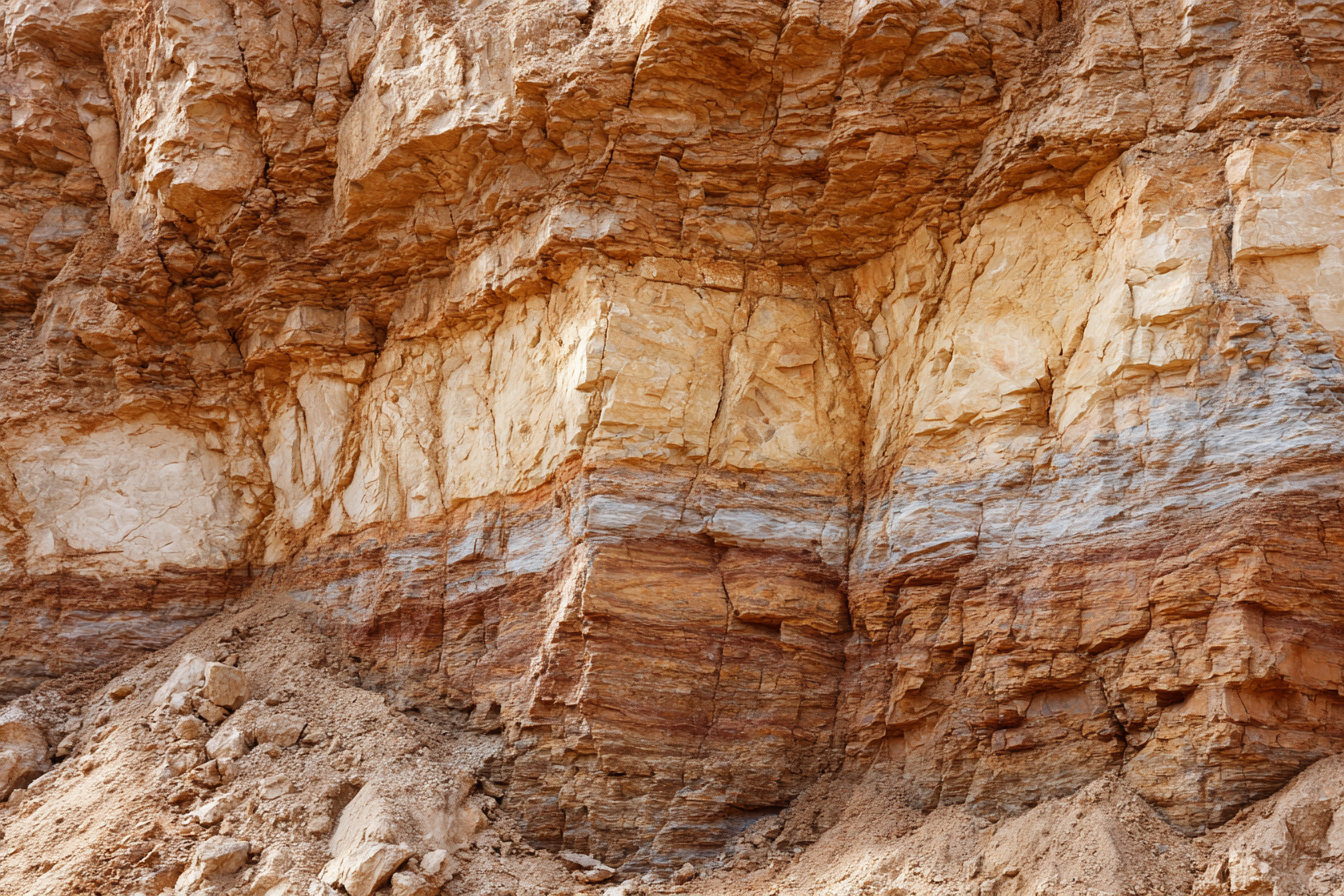
Stone deposits form according to geological processes that operate across incomprehensible timescales. Limestone, composed largely of calcium carbonate, accumulates in shallow seas, layer upon layer of shell and sediment compressed under the weight of time. Granite forms deep within the earth, molten rock cooling slowly to create interlocking crystals of feldspar, quartz, and mica. Slate forms when shale—itself created from compressed clay and silt—undergoes heat and pressure that aligns its minerals into planes that split reliably into thin sheets.
The character of stone is determined by its origin. A limestone quarried from a deposit formed sixty million years ago will have different mineral composition, porosity, and strength than limestone from a deposit formed in a different era and climate. The stone's color, grain structure, and hardness all reflect the specific conditions of its formation. When a structure is built from local stone—stone quarried within a reasonable distance—there is a correspondence between the building and the ground beneath it. The foundation and the walls are made of the same matter.
Quarrying extracts this material from the earth. The process is straightforward in its principles: stone is exposed, holes are drilled, wedges are driven in, the stone fractures along planes, and blocks are separated and transported. The scale may vary from small operations extracting specialty stone to enormous quarries that remove thousands of tons annually. Regardless of scale, quarrying creates a scar in the landscape that marks where material has been taken. This scar is permanent at any observable timescale, though geological processes will eventually soften it. The work of extracting stone requires equipment, skill, and time. The economics of quarrying have shaped which stones are available in which regions and at what cost, a pattern that has influenced building traditions for centuries.
Timber from the Forest
Forests grow according to climate, soil, and sunlight. The rate of growth, the density of the wood, and its structural properties depend on the tree's species and its growing conditions. A softwood harvested from a fast-growing plantation will have different characteristics than timber from an old-growth forest where trees grew slowly over many decades. Slow growth produces denser wood with tighter grain, wood that tends to be more durable and stronger.
Timber is harvested from forests managed for that purpose. The geographic location of these forests determines which species are available and, consequently, which materials are at hand for construction. In regions where large, straight timber grows readily, wooden frame construction becomes practical and economical. In regions where suitable timber is scarce, stone or masonry becomes the preferred structural material. This geographic reality has shaped building traditions around the world.
The act of harvesting timber from a forest is work that takes time and skill. Trees are felled, limbs are removed, logs are transported to mills where they are cut into usable lumber. The wood then seasons—loses moisture gradually to reach equilibrium with the surrounding air—a process that takes months to years depending on the species and thickness. Wood that is green, containing too much moisture, will warp and check as it dries. Properly seasoned timber is stable and ready for use. This timing is part of the material's nature: wood requires patience.
Aggregate from Rivers and Beds
Sand and gravel are found where water has done the work of sorting particles by size. Rivers transport these materials downstream, depositing them in bars and beds. Glaciers ground rock into fine particles that settle in valleys and plains. In coastal areas, ocean waves sort sand into beaches. These deposits of aggregate—stone particles ranging from dust-fine sand to pebbles—are the product of weathering and transport across years and millennia.
Aggregate is quarried or dredged from these deposits. The extraction process is often straightforward—the material is already sorted and sized by natural processes. When crushed stone is needed rather than naturally rounded aggregate, dedicated stone quarries process rock through crushers and screens to produce the desired size range. The location of aggregate deposits has determined where concrete can be produced economically. Regions near rivers or glacial deposits have access to abundant sand and gravel. Regions distant from these sources must transport aggregate long distances, raising costs and embodied energy.
Aggregate forms the bulk of concrete, the primary binding agent in modern construction. The quality of the aggregate—its cleanliness, its size distribution, its durability—directly affects the quality and longevity of the concrete. Aggregate composed of soft or reactive minerals will cause concrete to deteriorate prematurely. Aggregate containing clay or organic material can fail under load. Understanding the origin of aggregate means understanding what minerals comprise it and how stable those minerals are across time.
Clay and Mineral Extraction
Clay deposits form in ancient lake beds and ocean basins where fine particles settled in layers. These deposits exist in specific geographic locations, making brick and tile production dependent on access to suitable clay. Different clay deposits have different mineral compositions—some produce harder, more durable brick; others are softer or more prone to weathering. A brick made from local clay will have qualities determined by that clay's composition.
Mining operations extract clay and other minerals from the earth. Depending on the deposit, this may involve strip mining—removing overburden to expose the material—or shaft mining when deposits lie deep. The extracted material is then processed: clay is mixed with water, formed into shape, and fired in a kiln at high temperature, a transformation that makes it permanent. Mineral deposits for other purposes—metals, rare earth elements, sulfur—require similar extraction and processing. Each of these operations creates a permanent change in the landscape.
Material Place
The origin of a material is not merely historical or poetic information; it is technical information. The material's properties—its strength, its durability, its color, its texture—are direct results of where it comes from and how it was formed. A structure built from materials sourced locally, from the geology of the ground beneath it, will have an inherent coherence with its site. The stone in the walls matches the stone in the foundation. The timber reflects the forest that grew in the region. The clay brick absorbs water according to the firing techniques and mineral composition determined by local deposits.
Over decades and centuries, this local correspondence becomes visible. The stone weathers at a rate consistent with the climate and the properties of the stone itself. Water penetrates at rates determined by the stone's porosity. The timber moves with seasonal moisture changes in a way that reflects its species and the conditions it grew in. Maintenance and repair work with materials of the same origin or quality maintains the building's coherence.
Understanding material origins is understanding geology, geography, and the physical properties that flow from them. It requires attention to where things come from and what that origin means for how they will behave across time. A building is, in the deepest sense, made of the ground it stands on or of the earth transported from elsewhere. The quality of that material, the durability of that material, and the appropriateness of that material for the structure it supports are all questions answered by understanding its origin.