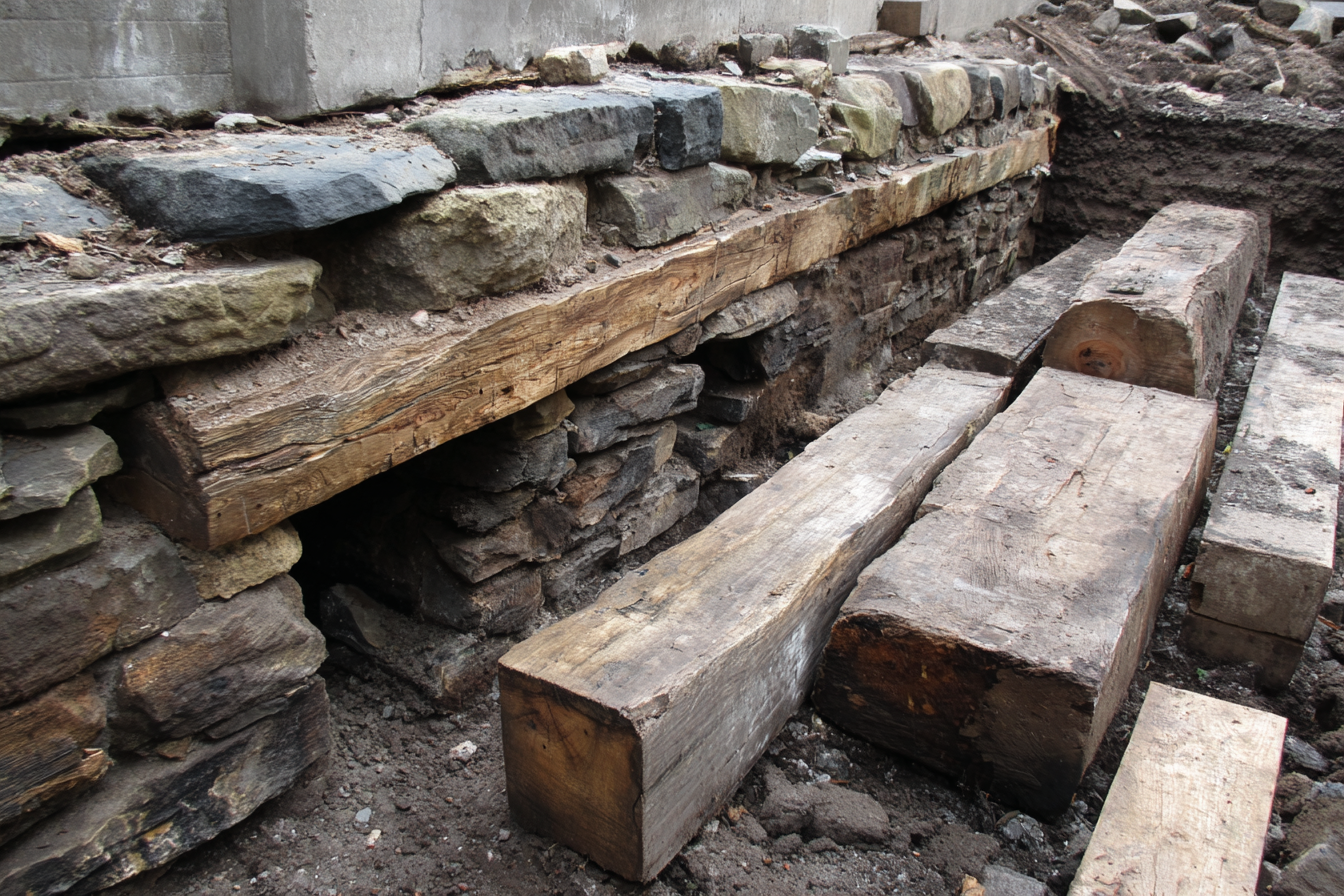
Dissolution
A building reaches a moment when the work of repair can no longer outpace the work of time. The cracks return in the same places. The settling continues despite the reinforcement. The materials themselves begin to signal their exhaustion—wood that will not hold a nail, masonry that crumbles under its own weight, structural timbers whose internal decay cannot be seen until the wall is opened. This is not failure. This is completion. The structure has done its work; entropy, which has always been patient, has finally made its claim.
The Threshold
Before a building reaches dissolution, it passes through a period where maintenance and repair hold back inevitable decline. This period can last decades, even centuries, depending on materials, climate, and the steadiness of care. But there arrives a moment—often subtle, sometimes sudden—when the trajectory shifts. The costs of repair begin to exceed what the structure can credibly promise in return. Not because the work is impossible, but because it must be done again, and again, at shrinking intervals, until the building becomes less structure and more scaffolding for its own preservation.
The threshold is not always marked by catastrophic failure. More often it announces itself through smaller signs: hairline cracks that reappear within months of tuck-pointing; wooden members that soften when probed; foundations that have settled unevenly across the footprint, straining the frame beyond what fasteners can tolerate. These are communications from the building itself. The masonry speaks through its deterioration pattern. The frame speaks through the load paths that no longer align. To recognize this threshold is to listen to what the structure is saying about its remaining capacity.
The decision to allow dissolution differs fundamentally from abandonment. Abandonment is neglect—a refusal to maintain. Dissolution is recognition. It is the disciplined acceptance that maintenance becomes a form of harm when the underlying structure cannot sustain what is being sustained. The building itself determines the moment. The signs are legible to sustained attention.
Careful Unmade
When dissolution becomes inevitable, the alternative to immediate collapse is not preservation but disassembly. This is not demolition in the sense of violent destruction. It is the reverse process of construction: a methodical taking-apart, layer by layer, in the opposite order from which the building was assembled.
The roof comes first. Shingles, underlayment, decking removed in sequence. The roof trusses are documented—their geometry, their joining methods, the quality of their material—before being carefully lowered. There is no haste in this work. Each element is examined as it is exposed. The rafters are checked for species, for defects, for the marks of the sawmill that cut them. Beneath the roof, the walls are freed of their load, grain by grain. Interior finishes and framing are segregated—plaster from brick, lath from wallcovering, each category handled according to its properties and its future.
The structural frame comes next. Posts and beams are disconnected in reverse-load order. The connections—mortise and tenon, lap joint, mechanical bolts—are examined before they are separated. Some joints are so integrated with their materials that they cannot be parted; these sections move as unified pieces. Others, designed with disassembly in mind, come apart cleanly. The frame that was built in weeks is taken down in months. This patient reversal is not inefficient; it is how material value and knowledge are preserved.
The foundation remains. Below-grade concrete, stone footings, clay-based mortar—these elements often outlast the structure they supported. The ground itself is part of the account. The soil beneath the footprint becomes compressed and altered by the building's weight. Drainage patterns have been diverted for the entire tenure of the structure. When the building is removed, the ground remembers.
What Endures
Material dissolution is not universal. Some substances have exhausted themselves and cannot be recovered. Wood that has rotted beyond its surface — where the decay has reached the heartwood and the fibers separate under slight pressure — has crossed a threshold from which no repair can retrieve it. The cellulose has been consumed. The structural identity of the timber is gone; what remains is soil in the shape of a beam. For these materials, dissolution is indeed a completion. They cannot be cycled into new service. They can only be returned to the ground from which they originally grew.
But the majority of a building's material body can continue. Timber that has been sheltered — interior framing, roof structure protected by sound cladding, beams kept dry and out of sustained ultraviolet exposure — often emerges from disassembly in remarkable condition. The cellular structure has stabilized over decades. The wood will not suddenly warp or fail in new application; it has already survived the acute phase of dimensional change. The distinction is exposure: timber that has spent its service life wetted and dried, baked by sun, or in contact with soil will have aged very differently from timber that was kept under cover. The protected wood is often harder, denser, and more dimensionally stable than anything newly milled. Timber from disassembled frames becomes joinery stock, flooring, structural members in smaller buildings. Its history of service becomes part of its specification.
Stone, if not damaged by freeze-thaw cycling or chemical decay, requires only cleaning and repointing. The stone itself does not weaken with age; it stabilizes. A limestone block that has absorbed centuries of moisture and pollutants can be freed of its surface deposits without loss of structural properties. The patina of weathering is not damage but genuine record: the accumulated exposure to sun and rain and seasonal cycling has made the surface harder, more resistant to further change.
Metals present the cleanest reclamation path. Steel can be melted down without loss of properties. Copper can be drawn into wire or cast into new form. Iron, if not so deeply corroded as to be structurally compromised, can be cleaned and refined. The metal loses its biography in the remelting, which is acceptable because metal does not carry the temporal signature that timber or stone retains. Reused metal is genuinely new metal; the previous form was only its temporary manifestation.
Even smaller elements contribute: fasteners sorted by type and cleaned, dimensional lumber that can be milled into smaller stock, brick that can be carefully extracted from mortar through the application of controlled force. The process of disassembly becomes a material inventory that maps the building's composition and offers each element according to what it can become.
The Cleared Ground
What remains after dissolution is not void. The footprint carries memory in its deformation. The soil compacted under load for decades or centuries does not immediately decompress. The foundation remnants—the parts too expensive or too embedded to extract—become artifacts of subsurface geometry. Drainage systems installed to protect the building continue to influence how water moves through the site. The grade of the ground may be noticeably different from its surrounding terrain, a subtle depression or elevation that marks where mass once stood.
This is not blank slate. A cleared site is an archaeological palimpsest. It is the ground with knowledge embedded in its structure. Plants may grow differently where the soil was enriched or depleted by the building's presence. Microtopography preserves the ghost of the lost structure. The site has been fundamentally altered by the years of occupation, and these alterations do not vanish when the building is removed.
Building Toward Dissolution
Some structures are conceived with their inevitable disassembly already considered. This is rare, but it is the logical endpoint of thoughtful design. Bolted connections instead of welding allow members to be separated without destruction. Mechanical fasteners instead of adhesives permit material segregation. Materials are chosen not merely for their performance in service but for their behavior at the threshold of that service—what they become when they are disassembled and offered to new purpose.
A roof designed for eventual replacement uses fasteners that can be backed out cleanly rather than nailed flush. A floor frame uses mechanical connections that can be unfastened rather than lap-jointed so tightly that separation requires cutting. Interior partitions are detailed so that their removal does not damage the underlying structure. These decisions, made at the time of design and construction, acknowledge that dissolution is not an aberration but the final stage of every building's life.
This is not pessimism. It is realism of the deepest kind. Everything maintained is maintained against the gradient of entropy. The building that lasts longest does so not by fighting this gradient eternally, but by accepting it and shaping itself accordingly. Materials that can be disassembled without destruction are materials that assume their impermanence and plan for it. This is durability in its truest form—not the stubborn refusal to change, but the elegant acceptance of change and the design that facilitates it.
The threshold at which repair becomes futile, at which dissolution becomes the only honest path, is not a threshold of failure. It is the completion of a building's service life. The structure has done what it was meant to do. The materials that comprise it have given what they have. And what endures—the timber, the stone, the metal—carries its service history into new forms, and the cleared ground remembers.