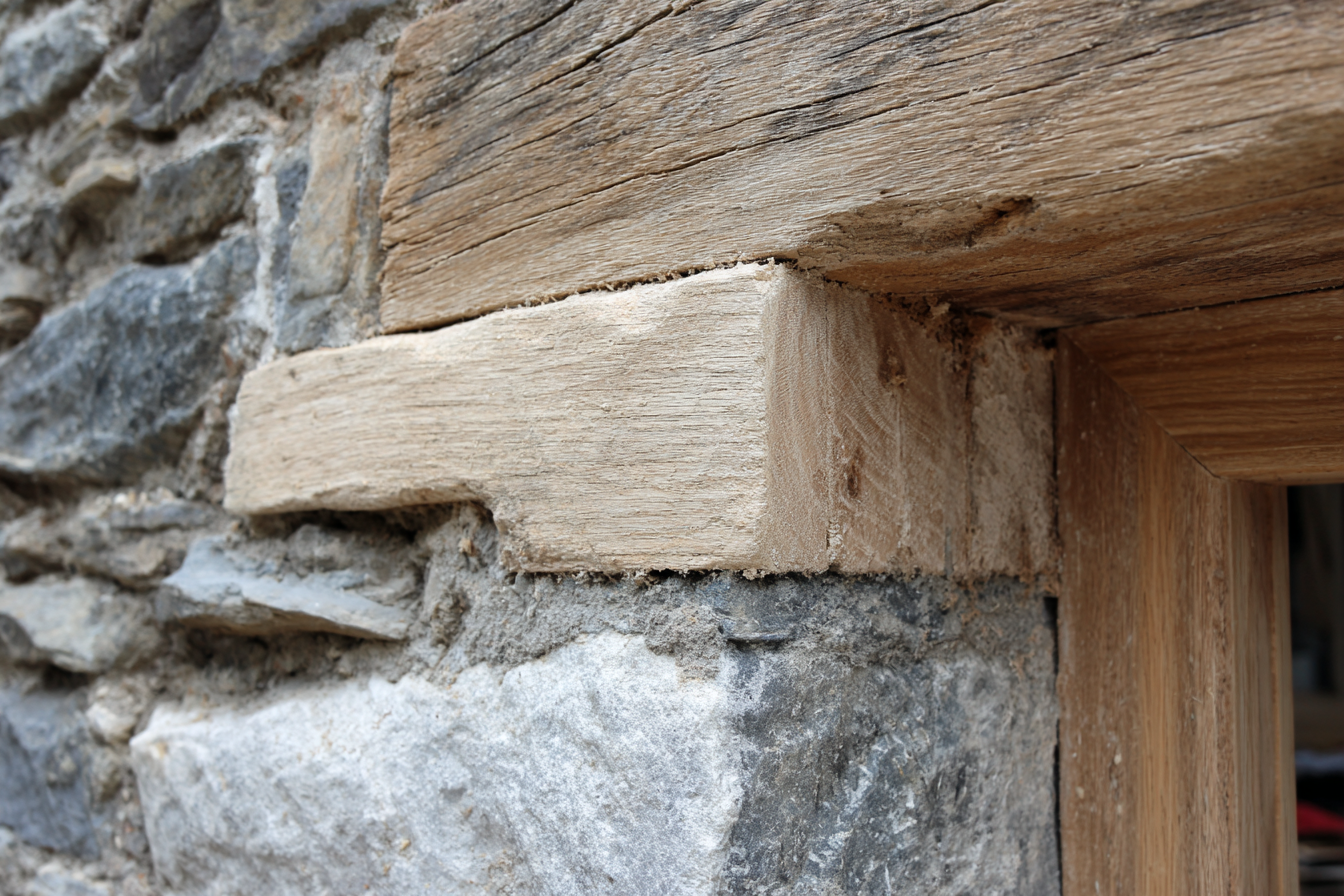
Adaptation
An old building is a text written in materials. To read it well is to understand not just what it is, but what it wants to become.
Reading the Structure
Every old building arrives with a history embedded in its construction. Thick walls suggest climates where thermal mass matters. Deep window recesses reveal the depth of load-bearing masonry. Particular orientations, room arrangements, and mechanical systems all reflect the logic of an earlier moment—decisions that were not random but precise responses to place, available materials, and the conditions of an earlier era.
Before changing anything, a building must be read. This means understanding how it actually performs: where air moves through it, where temperature shifts occur, where moisture accumulates or dries. Many old buildings have already solved complex problems in ways that modern analysis initially overlooks. A stone wall with centuries of weather-tightness has adapted through micro-failures and repairs, settling into a performance that is not always predictable from theory. High ceilings and operable windows create ventilation patterns that mechanical systems often try, unsuccessfully, to replicate. Orientation and mass work together in ways that were intuitive when they were designed and can seem primitive until their subtlety becomes apparent.
The Logic of Existing Materials
An old building's envelope is not a uniform barrier but a layered conversation. Brick absorbs moisture and releases it. Lime mortar is softer than the brick it holds, by design—allowing flexibility and sacrificing itself rather than demanding the masonry fail. Plaster applied to stone or brick can move with seasonal cycles in ways that rigid modern coatings cannot.
The danger of retrofit work is imposing a new logic onto this old one. Installing a vapor barrier on the wrong side of a wall prevents moisture that has accumulated for decades from ever leaving, creating wet conditions that the materials were never designed to resist. Rigid insulation applied directly to interior masonry can trap moisture between the insulation and the wall, accelerating deterioration that the building had previously managed. Sealing cracks with modern sealants prevents the micro-movements that allowed the structure to shed water over time.
Adaptation requires respecting the material's original language rather than forcing a new one. This often means working with softer approaches: improving drainage before improving insulation, allowing air to move rather than preventing it entirely, selecting materials that have properties similar to what came before.
The Visible Layers of Time
Many old buildings show evidence of multiple cycles of adaptation. A wall might have brick laid in lime mortar, repointed with Portland cement in a later era, patched with cementitious filler in another, and carefully repointed again with breathable lime in the most recent repair. These layers are not failures—they are proof of continuity. The building survived not by remaining unchanged but by absorbing change while maintaining its fundamental structure and purpose.
This visible history is instructive. It shows what interventions lasted and what failed. Places where water got in and then got out again. Repairs that held for a century and those that broke apart after two decades. The building itself has already run thousands of experiments in adaptation, and its surface tells the story of what works.
Window Proportion and the Grammar of Openings
Windows are where adaptation often goes most visibly wrong. A new triple-glazed unit installed in an old window frame that was designed for single pane glass changes the visual weight, the depth of the recess, the shadow pattern that the original proportions created. The building's face becomes a mismatch between what it shows and what it contains.
Proper window renovation respects the original opening, the depth of the reveal, and the proportions of the sashes. When insulation is necessary, interior storm windows preserved in the deep recess of the original opening can provide thermal improvement while leaving the visible facade and the thermal behavior of the deep recess undisturbed. Secondary glazing, when done thoughtfully, works within the existing frame rather than replacing it.
The same principle applies everywhere: the building's grammar of proportions and depths is part of what makes it durable. When these are disrupted, the building no longer reads as itself, and the sense of continuity that allows adaptation is broken.
When Not to Change Anything
Paradoxically, sometimes the most important adaptation work is recognizing when the old system is already performing adequately and leaving it alone. A building with proper roof maintenance, functioning drainage, and ventilation might be wasting energy by modern standards, but introducing a heating system or rigid insulation could create new problems where none existed.
The question is not whether something is inefficient by contemporary metrics, but whether the adaptation required will respect what is already working. High ceilings require more heating, but they also allow natural convection, stratification of temperature, and air movement that produce notable thermal stability. The building may be using energy in ways that seem wasteful until the realization arrives that equilibrium is maintained with fewer interventions than a modern design would require.
Some buildings show this sophistication throughout. Their orientation, their thermal mass, their ventilation patterns work together in ways that are neither obvious nor easily improved by standard retrofit procedures. These buildings should be understood before they are changed. Often, the best adaptation is light intervention: better operation of existing systems, careful sealing of obvious air leakage, improvements to drainage, maintenance of what already works.
Insulation in Conversation with the Envelope
Where insulation is genuinely needed, the choice of approach depends on understanding what the building already does. External insulation protects the existing structure and maintains the building's thermal mass, but it changes the building's appearance and can introduce new water management challenges if not done with care to existing details. It also, crucially, changes the building's relationship to its surroundings—the texture, depth, and proportions shift.
Internal insulation preserves the exterior appearance but sacrifices the thermal mass of the walls, creates a new interior surface that changes room proportions, and requires careful attention to moisture. Some buildings are suitable for internal insulation; in others, the loss of the original interior surface geometry and the thermal properties of the wall creates more problems than it solves.
The choice is not theoretical but material and specific to each building. What works depends on where the building is, what it is made of, how it is ventilated, and what its original thermal performance actually is rather than what tests predict. A building might be "inefficient" by design standards yet remain thermally stable for decades because its thick walls, its north-facing stone, and its small openings create a stable internal environment that modern heating systems would paradoxically destabilize.
The Craft of Repair
Adaptation as a practice is less about retrofit procedures than about a slow attentiveness to what the building reveals. Repointing mortar in old masonry is not a technical task but a craft—understanding what mortar was there before, what properties it needs to have, whether the job is to match the original exactly or to gently improve it while staying within its logic.
Similarly, when windows need work, the question is not whether to replace them with modern equivalents but whether they can be restored, what that restoration requires, and what it reveals about the original construction. Old windows often work better than expected once they are properly maintained and sealed. The sashes move smoothly, the weights and pulleys operate, the glass performs adequately when the installation is tight. Replacing them means losing both the material evidence of time and, often, a performance that is underestimated because it is familiar.
This craft knowledge accumulates through repetition and attention. It cannot be proceduralized. Each building requires seeing what is actually there, understanding why it was done that way, and deciding whether to preserve it, repair it, or carefully extend it with something that respects its original logic.
Multiple Lives Across Centuries
The most durable buildings in any landscape are those that have been adapted multiple times. A medieval structure that became a warehouse, then a residence, then offices, and then cultural space carries this history in its form. Its durability comes not from being preserved as a monument but from being continuously useful and continuously adapted to new purposes. Each adaptation added what was needed and often removed what was no longer necessary, leaving the essential structure intact.
This kind of adaptation happens at a pace that allows learning. The cracks that appear are informative. The moisture that emerges in winter shows where the envelope is weak. The failures are relatively small and can be addressed specifically. The building lives through its problems and reveals, over time, what matters and what does not.
An old building that survives into a new era has proven something: that its fundamental logic is sound, that its materials are durable, that adaptation is possible. Working with that evidence rather than against it—respecting the building's own momentum and the lessons it has accumulated—is the work of extension, not replacement. It is the work of tending a structure that is already halfway to its next century.