Daylighting
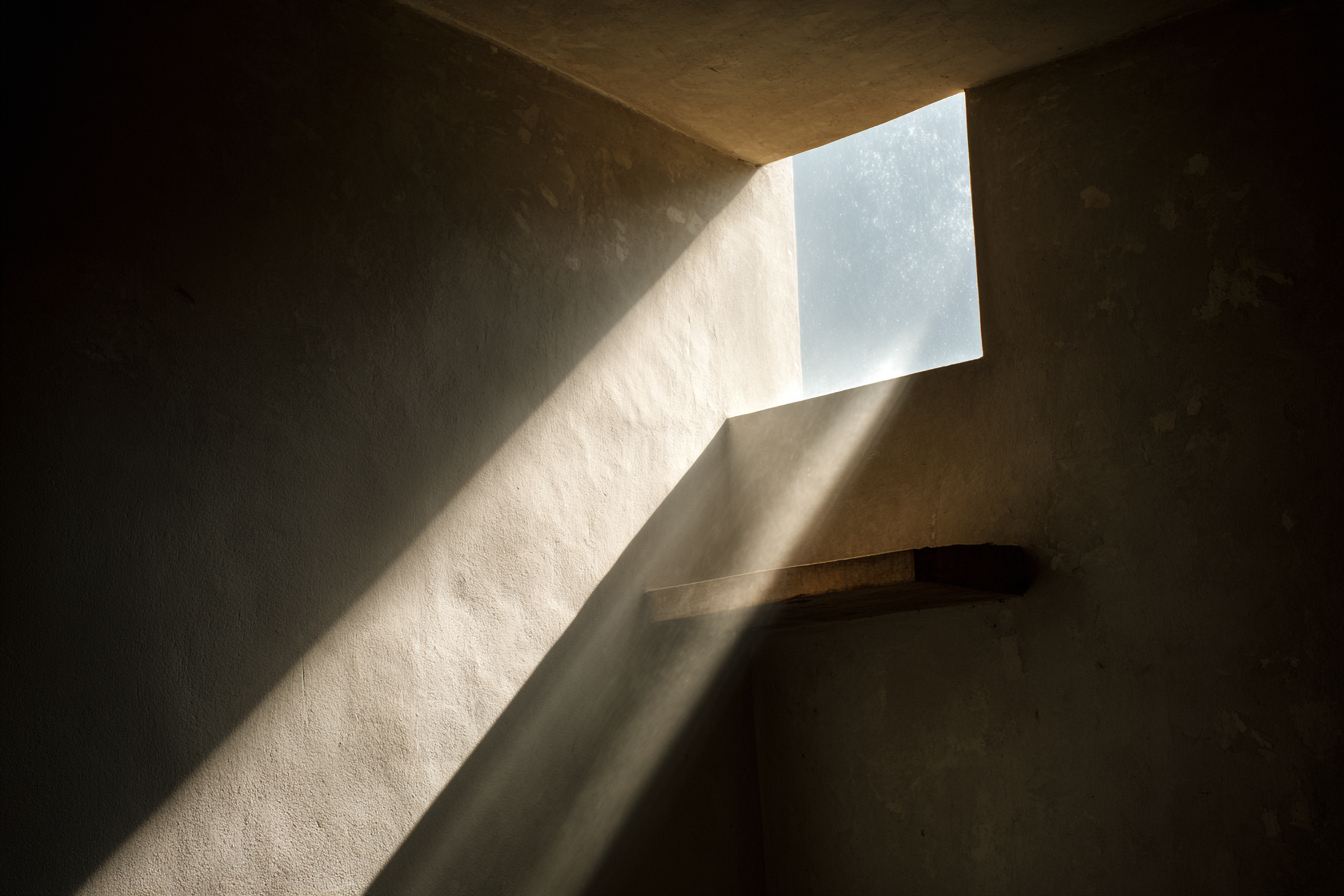
Light arrives at buildings in two distinct forms. Direct sunlight creates sharp shadows, visible geometry, and thermal gain. Diffuse skylight—scattered by clouds and atmosphere—arrives from all directions at once, even and shadowless. A building's envelope must discriminate between them, admitting one while rejecting the other according to season and orientation. This mediation is the work of daylighting: not simply letting light in, but controlling when, where, and how much.
The Aperture as Selective Barrier
The window exists in fundamental tension. It opens the wall to the outside—admits light, provides views, allows air exchange—while simultaneously sealing the building against weather, heat loss, and solar gain. This dual role means every aperture is a negotiation between transparency and thermal resistance, between admitting daylight and managing the energy consequences of that decision.
Glazing transmits light selectively. Clear glass passes roughly 88 percent of visible light but allows nearly all solar radiation through. Low-emissivity coatings—thin metallic or oxide layers applied to glass surfaces—alter this behavior. These coatings reflect infrared radiation back outward while remaining transparent to visible light, reducing heat transfer through the pane. The trade-off is measurable: a low-E coating that cuts winter heat loss also slightly reduces visible light transmission and changes the color temperature of transmitted light, shifting the quality of daylight inside.
Multiple panes separated by air or insulating gas further complicate the system. Each pane reflects some light at its surface; two panes create two reflective surfaces. The air gap itself becomes an insulating chamber. The result is a more thermally efficient assembly—critical in cold climates—but one that reduces light transmission and introduces subtle reflections in the glazing plane. A building in a heating-dominated climate may accept these losses as necessary. In a heating and cooling climate, or in orientations that receive harsh afternoon sun, the same configuration becomes beneficial.
Geometry and the Seasonal Sun Angle
The sun's path shifts dramatically across the year. At latitude 40 degrees north, the winter sun peaks at roughly 27 degrees above the horizon at solar noon; the summer sun climbs to 73 degrees. This 46-degree difference in altitude angle means identical glazing and overhangs perform completely differently across the seasons—a fact that simple energy ratings fail to capture.
An overhang of fixed depth extends from the top of a south-facing window. During summer, when the sun is high, the overhang's shadow falls across the upper glazing and reflects deeper into the building, blocking direct radiation. In winter, when the sun is low, the same overhang casts a shadow on the ground far from the wall; the window receives full direct sunlight. The relationship is geometric and absolute: overhang depth, window height, and latitude determine exactly when shadowing begins and ends. No adjustment is needed. This is why south-facing overhangs remain the most effective fixed shading strategy in cold climates—they reject summer heat while admitting winter warmth.
East and west orientations receive direct sun at low angles, creating a harsher problem. The morning and afternoon sun strike nearly horizontally, penetrating deep into the building regardless of season. Vertical fins or louvered screens become necessary, as they intercept low-angle radiation more effectively than horizontal overhangs. The angle of these fins must be calculated for latitude and the specific facade orientation to be effective; rough approximation is insufficient.
North-facing glazing receives no direct sun, only diffuse skylight. This allows larger glazed areas with minimal thermal consequence, though the light itself is cool-toned and constant throughout the year, changing only in intensity with cloud cover and season.
Transmitting Light Deeper into Space
Daylighting becomes strategic when it reaches beyond the perimeter. Near a window, direct and diffuse light creates adequate illumination. Three or four meters back, illumination falls sharply. Clerestory windows and light shelves extend the reach of daylight into the building's interior.
A light shelf is a horizontal reflective surface positioned at mid-wall height, usually just below a high window. Direct sunlight or skylight striking the shelf bounces upward toward the ceiling. The ceiling—if sufficiently reflective and positioned correctly—bounces this light back down and deeper into the room. The math is straightforward but precise: the shelf depth, its reflectance, the window height, and the ceiling reflectance must work together. A shelf that is too shallow accomplishes little; one that is too deep blocks the view to the outside while failing to reflect light adequately. The reflective surface itself must be durable and maintain its finish; once dulled by dust or deterioration, effectiveness declines rapidly.
Clerestory windows—glazed openings high in the wall or positioned above adjacent rooflines—bypass the ground plane entirely and admit light into upper portions of tall spaces. These windows can be oriented or shaded to admit diffuse north light or controlled direct light from east, west, or south, depending on the building's latitude and cooling load. The trade-off is architectural: clerestory windows sacrifice wall surface and create visual complexity in the external elevation.
Active and Fixed Shading
Fixed overhangs and fins optimize for a single season and perform less effectively in shoulder months. Adjustable shading systems—louvers, shutters, roller shades, or retractable screens—introduce a responsive layer between the building envelope and the sun.
Operable louvers, installed externally, remain superior to internal shades because they intercept solar radiation before it strikes the glazing. External louvers that are manually adjusted allow seasonal tuning: opened flat to horizontal in summer to block overhead sun, tilted or raised in winter to admit direct radiation. In heating-dominated climates, fixed overhangs often suffice. In climates with significant cooling loads and variable seasonality, adjustable external shading provides flexibility that fixed geometry cannot.
The practical challenge with adjustable systems is maintenance and reliability. A louvered screen that corrodes or becomes stuck serves neither function. Mechanical shutters require regular operation to remain functional. In regions with severe weather or salt air, the durability of moving parts becomes a primary design concern. Some buildings resolve this by accepting fixed shading that performs adequately across most conditions, reducing the mechanical burden.
Roller shades and interior louvers are easier to operate and maintain but are thermally ineffective. Once direct sunlight passes through glazing into the building interior, the heat is already inside. An interior shade may reduce glare and diffuse the quality of light in the space, but it cannot prevent thermal gain. This limitation has driven a shift in contemporary practice away from interior-only shading in climates with significant cooling loads.
Orientation and Building Siting
Orientation determines the scale of the daylighting problem before any window is drawn. A long south facade receives abundant direct sun that is geometrically manageable with overhangs. The same building rotated 90 degrees presents two east and west facades that demand continuous high-angle solar control and make overhangs ineffective. Siting and massing decisions made early in design—decisions often driven by site constraints, street frontages, or program—establish the daylighting requirements for years to come.
The quality of daylight itself shifts by orientation. South light is bright and warm, advancing through the day and season. North light is constant, cool, and shadowless—ideal for certain tasks but monotonous if it is the only light source. East light brings intensity in morning hours, declining through the afternoon. West light arrives late and intensely, creating afternoon glare. A building with apertures on all four sides experiences a dynamic daylighting environment but faces complex control challenges. Buildings with apertures concentrated on one or two orientations simplify control but sacrifice the variety and flexibility that orientation diversity provides.
The surrounding context—adjacent buildings, vegetation, terrain—modifies the available daylight dramatically. A north-facing wall in an urban canyon receives significantly less daylight than the same orientation in an open setting. Deciduous trees shade windows in summer while allowing light through in winter. These site conditions shift the balance of fixed versus adjustable shading and the feasibility of deep daylighting strategies.