Passive Cooling
A building designed to stay cool without machinery performs a kind of thermal arithmetic that begins with the sun and ends with night air. The strategies are ancient, but they remain the most reliable cooling systems available — not because of romanticism, but because they work through physical principles that don't fail or require replacement.
Stored Coolness
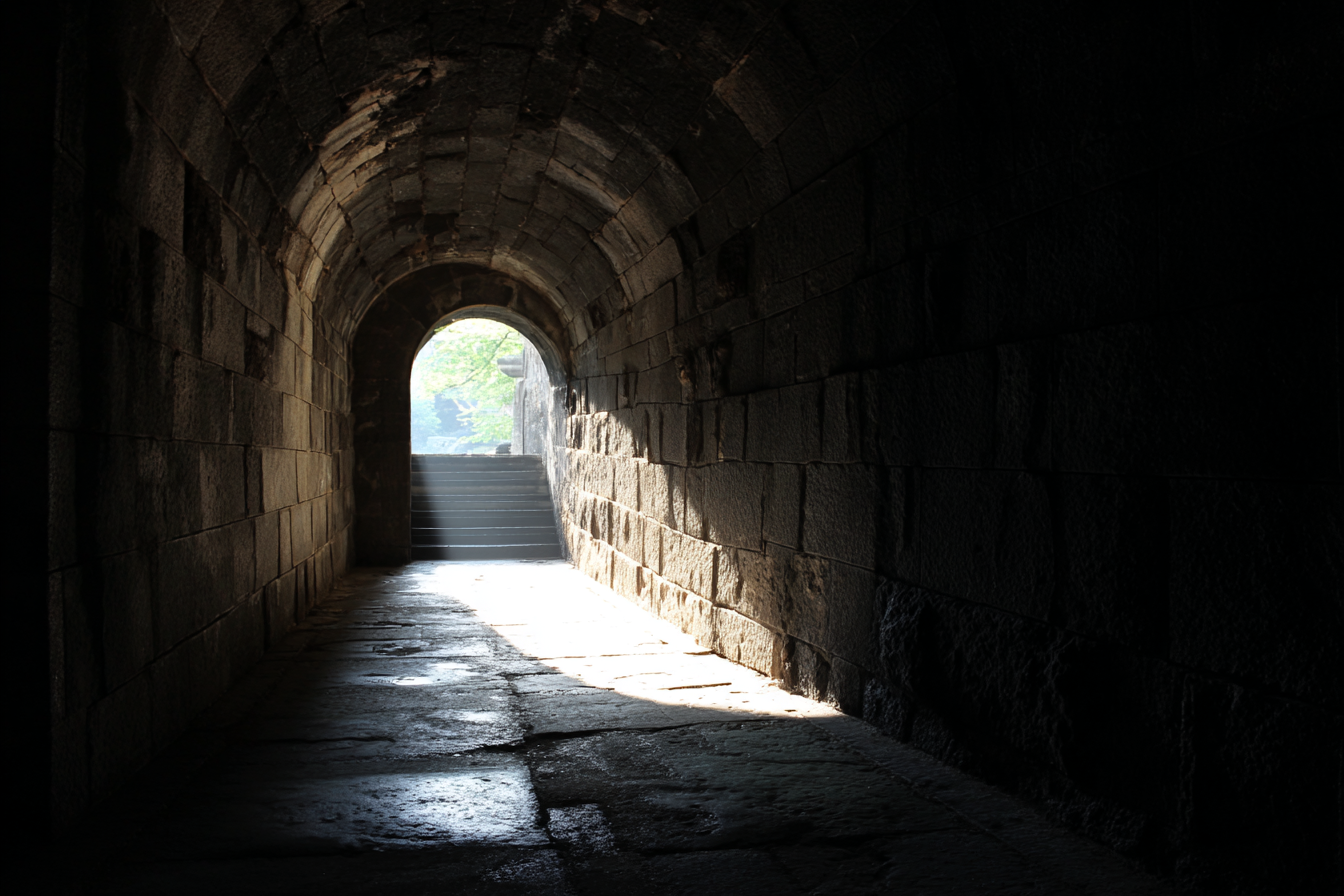
The experience of walking into a thick-walled building on a hot afternoon carries a distinct sensation: coolness that persists from many hours before, when the night was cold and the building was closed. This is thermal mass at work, though the feeling is more direct than the name suggests. A stone wall or concrete structure absorbs heat during daylight hours but does so slowly, its density and conductivity creating a lag between the external temperature and the interior surface. The interior stays cool even as external air climbs toward its peak because the material itself hasn't yet warmed through.
This thermal buffer depends on thickness and material choice. A thin wall heats quickly and cools quickly, offering little protection. But a wall measured in feet rather than inches creates a genuine time-shift in temperature. Heat entering at the outer surface takes hours to migrate inward, and by the time it reaches the interior surface, the external temperature has already begun to fall. The building exhales the stored warmth back outward as evening approaches.
The cooler air that pools inside feels especially dense because it is — the building has genuinely stored coolness, not merely insulated against heat. The distinction matters. The thick-walled building doesn't fight the heat; it accepts it into its mass while protecting the interior void, then releases it when the temperature differential reverses.
Geometry of Shade
Shading architecture requires calculation, though the calculation happens at the design stage and then becomes permanent geometry. An overhang above a south-facing window must be deep enough to block the high summer sun while allowing the lower winter sun to enter. This dimensional relationship changes with latitude, and a shade that works perfectly at one location provides little protection a few hundred kilometers away. Yet the principle is observable everywhere: the window recessed deep into a thick wall, the extended cornice that throws shadow across the facade, the colonnade that filters light while admitting air movement.
These are not decorative features incidental to cooling. They are the cooling system itself. A window that receives direct solar gain heats the interior far more efficiently than any shading device applied afterward. The heat enters as radiant energy, fast and direct. But a window shaded by its own frame depth, by an overhang, or by a screen casts shadow before that energy can enter glass. The temperature difference between a shaded and unshaded window is often ten degrees or more on a hot day.
Courtyards operate on the same principle at larger scale. A central void surrounded by walls receives sunlight for only a portion of each day, and the mass of the surrounding walls absorbs much of that radiant heat. The courtyard floor, shaded and exposed to less direct sun than the roof, remains cooler. Air moving through this space picks up that coolness through radiation and convection before flowing into the rooms that surround the void. The courtyard becomes a coolness reservoir at the center of the building.
Night Release and the Ventilation Cycle
Passive cooling completes itself at night. A building that has accumulated heat during the day can shed that heat if the interior is exposed to cooler night air. This requires opening — windows, doors, louvers, or other pathways that allow the night air to flow through the building and carry away the warmth stored in the mass.
But this ventilation must be timed. The building closes again before dawn, before the external temperature begins to rise. The moment when outside air drops below the interior target temperature defines the ventilation window. Open the building during those hours, close it as the sun approaches. By morning, the interior is cool again, and the walls have released their stored heat outward.
This cycle requires no pumps, no electrical controls, no replacement every five to ten years. Thermal drives the ventilation: cool night air outside creates a density difference that drives it into the building, displacing warmer interior air. The mass cools, the interior air flows out, and the building prepares itself for the next day. The sequence is reliable because it relies on temperature gradients and gravity, not on systems that fail or reach their cycle limit.
Water, Air, and Compound Strategies
The addition of water to a courtyard or interior void accelerates cooling through evaporation. Air moving across a water surface absorbs moisture and, in that process, releases latent heat to the water. The air cools beyond what the shade alone could achieve. The effect is most pronounced in climates where humidity is low — the air's capacity to absorb moisture is greatest when it starts dry — but it operates anywhere that water and moving air meet.
A fountain, a pool, even a wet floor creates a localized cooling effect visible in the way air temperature drops and the measurable coolness intensifies. The water doesn't cool magically; it participates in a thermodynamic exchange. The energy that would warm air instead evaporates water, and that energy is carried away in the moisture-laden air that exits the building.
These strategies compound. A building with thick walls and proper mass cools itself. Add shade geometry, and the interior receives less daytime heat to absorb. Add a courtyard effect, and that void becomes a coolness multiplier. Add night ventilation, and the building actively purges its stored heat. Add water, and the evaporative cooling reduces the temperature further. Each strategy alone provides some benefit. Combined, they create a thermal performance that mechanical systems struggle to match.
The distinction becomes apparent in late summer, when mechanical systems running continuously begin to fail from fatigue. Evaporative coolers lose effectiveness as humidity climbs. Air conditioning units consume so much power during peak hours that they strain electrical systems. But a building designed as a passive cooler — one that depends on its own mass, geometry, and ventilation — performs as steadily at the end of August as at the beginning of June. The performance doesn't degrade because it doesn't depend on consumption or mechanical reliability. It depends on stone that never wears out, shade that doesn't require replacement, and night air that arrives reliably every evening.