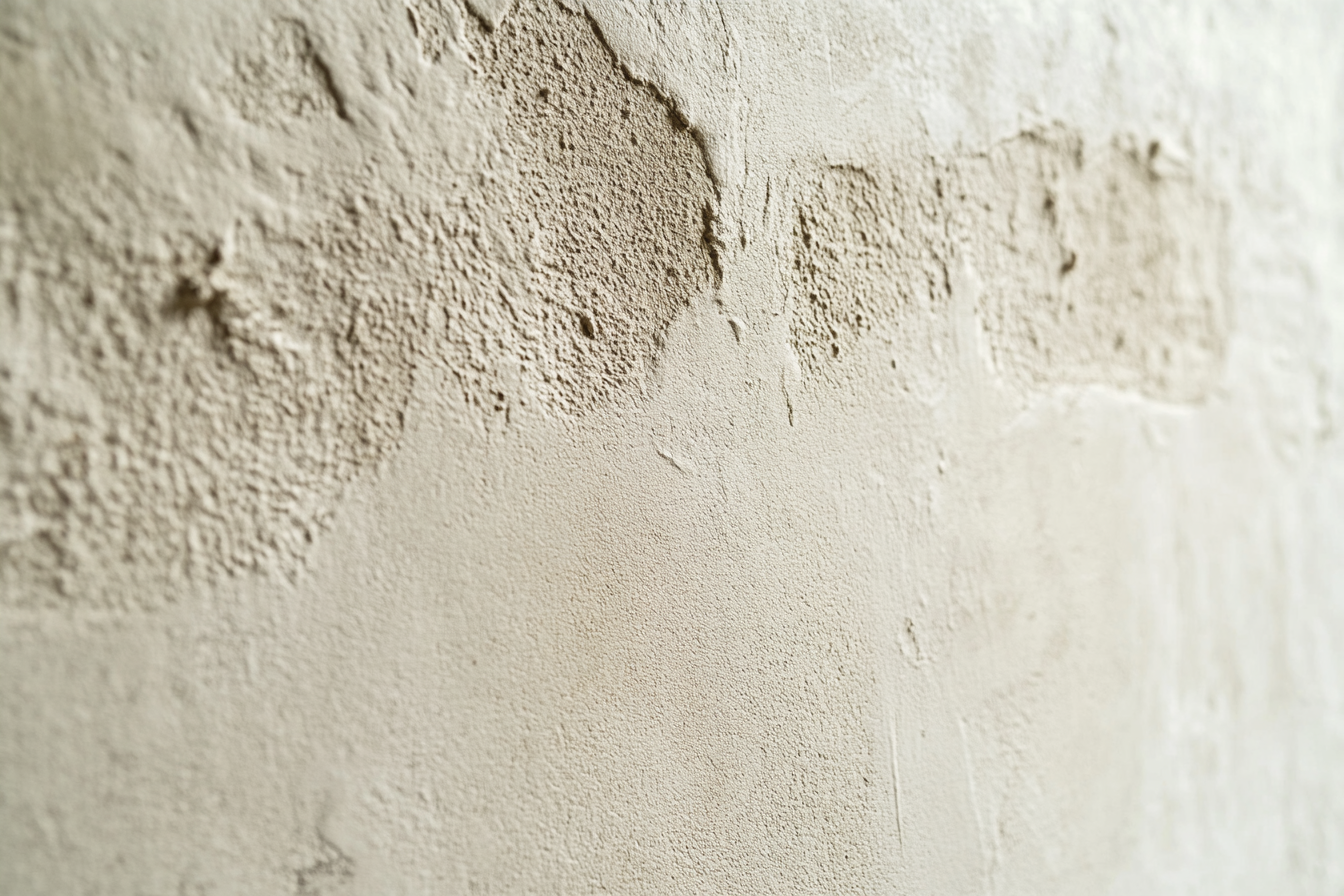
Natural Plasters and Renders
The plaster is where the building meets the air. It is the outermost layer of the wall — the surface that takes the rain, absorbs the sun, and mediates the exchange of moisture between the interior and the exterior. Everything behind it is protected by it. The plaster weathers so that the structure does not.
This is the essential function: sacrifice. A plaster coat is applied knowing that it will erode, crack, and eventually require renewal. The cycle is deliberate. The plaster absorbs the stresses that would otherwise damage the substrate — thermal expansion, moisture movement, UV degradation, physical impact — and it does so at a surface that can be repaired without disturbing the wall beneath. A lime render that is re-applied every thirty to fifty years protects the masonry behind it indefinitely. The requirement is periodic renewal. The result is a wall that does not age at the rate of its exposure.
Clay Plaster
Clay plaster is the simplest of the natural finishes: clay, sand, and fiber — typically chopped straw or animal hair — mixed with water to a workable consistency and applied to the wall surface by hand or trowel. The clay binds the sand particles; the fiber bridges cracks as the plaster dries and shrinks. The mix proportions depend on the clay's plasticity — a fat, high-plasticity clay requires more sand to prevent excessive shrinkage; a lean clay may need less.
The properties of clay plaster in service are distinctive. It is hygroscopic — it absorbs moisture vapor from humid air and releases it when the air dries, buffering interior humidity within a narrow range. A room plastered with clay maintains relative humidity between approximately 40 and 60 percent without mechanical intervention, which is the range associated with material stability and reduced biological growth. The buffering is passive, continuous, and requires no energy.
Clay plaster is also the softest of the natural finishes and the most vulnerable to water. A splash of rain on an unprotected clay surface will erode it. For this reason, clay plaster is best suited to interior surfaces and to exterior surfaces that are fully sheltered — deep under eaves, within covered porches, on walls that never receive direct rainfall. In these locations, its softness becomes an asset: it is easy to repair, easy to re-apply, and easy to modify. A patch of clay plaster blends into the existing surface within a season, as the color equalizes through moisture cycling and dust accumulation.
Lime Render
Lime render is the workhorse of exterior natural finishes. It is harder than clay plaster, more weather-resistant, and capable of protecting a wall face from direct rain exposure for decades between applications. The material is calcium hydroxide — slaked lime — mixed with sharp sand at a ratio of approximately one part lime to two and a half to three parts sand. When applied and exposed to air, the lime absorbs carbon dioxide and carbonates, converting back to calcium carbonate — limestone — over a period of weeks to months. The finished render is, in a chemical sense, a thin layer of reconstituted stone.
The carbonation process gives lime render its characteristic properties. It is hard but not brittle — its compressive strength of 2 to 5 megapascals is lower than cement render, which means it can flex with the wall beneath it rather than cracking rigidly. It is vapor-permeable — moisture can migrate through it and evaporate at the surface, preventing the moisture accumulation that causes frost damage, salt crystallization, and biological decay behind impermeable coatings. And it is self-healing: fine cracks in the surface are bridged over time as rainwater dissolves a small amount of lime from the surrounding render, carries it into the crack, and deposits it as the water evaporates. The crack fills with new calcium carbonate. The surface repairs itself.
Lime render is applied in multiple coats — typically two or three. The first coat, the scratch coat, is coarse and heavily textured to provide a mechanical key for the subsequent layers. The second coat levels the surface. The finish coat, if applied, provides the final texture and color. Each coat must be allowed to carbonate partially before the next is applied — rushing the process produces a render that is weak, powdery, and prone to delamination. The material sets on its own schedule, and the work follows.
Gypsum Plaster
Gypsum plaster occupies a different position from clay and lime. It sets by hydration — a chemical reaction with water that produces a crystalline matrix of calcium sulfate dihydrate — and it sets quickly, reaching working hardness within hours rather than weeks. This speed made gypsum the dominant interior plaster for much of the twentieth century, displacing lime and clay in applications where rapid turnover was valued.
The limitation of gypsum is water. Once set, gypsum plaster dissolves slowly in sustained contact with liquid water — it is, after all, a hydrated mineral that was formed by adding water and can be reversed by adding more. For this reason, gypsum is exclusively an interior material. On exterior surfaces, or in any location where water contact is possible, gypsum plaster will fail. Its domain is the dry interior wall and ceiling, where its smooth finish, rapid set, and ease of application make it effective and appropriate.
Application and Substrate
The compatibility between plaster and substrate is not optional. A plaster that is harder than the substrate will transmit stress to the wall beneath it, causing the substrate to crack or spall. A plaster that is too soft for its exposure will erode faster than the maintenance cycle can address. The matching must be correct: soft lime render on soft stone, harder hydraulic lime render on harder stone, clay plaster on earth walls, gypsum on interior lathing or board.
The application itself follows a logic common to all the natural plasters. The substrate must be clean, sound, and dampened — dry substrates pull water from the plaster too quickly, preventing proper curing; wet substrates dilute the mix and weaken the bond. The plaster is applied in thin coats — typically 8 to 15 millimeters per coat — and each coat is worked to the appropriate texture before it begins to set. Over-working produces a smooth, dense surface that may resist adhesion of subsequent coats. Under-working leaves voids and weak spots. The window of workability is specific to each material and each condition, and recognizing it is a matter of experience rather than instruction.
Surface and Time
A natural plaster surface changes over time in ways that synthetic finishes do not. Lime render develops a hard, crystalline surface patina as carbonation progresses — the outer millimeter becomes denser and more weather-resistant than the material behind it, creating a self-improving skin that hardens with age. Clay plaster darkens slightly as dust accumulates in its porous surface, developing a tone that integrates with the surrounding environment. Both materials show the effects of water — staining below window sills, darker patches where splash reaches, lighter areas where evaporation is fastest — and these marks are not defects but records of the wall's relationship with weather.
The renewal of a natural plaster surface is not a repair in the conventional sense. It is a continuation — a new layer applied over or in place of the old, using the same material and the same technique. The wall accumulates a stratigraphy of plaster layers over centuries, each one recording a period of maintenance and each one protecting the structure beneath. The plaster is the most transient element of the wall and, for precisely that reason, the most important. It is replaced so that nothing else needs to be.