Natural Fiber Insulation
All insulation works the same way: it traps air. Still air has a thermal conductivity of approximately 0.025 watts per meter-kelvin — lower than nearly any solid material. The function of insulation is not to insulate in itself but to hold air in place, preventing it from moving and carrying heat with it. What distinguishes one insulation from another is the material that creates the air pockets, how it behaves when wet, how long it lasts, and what happens to it at the end of its service life.
Natural fiber insulations — sheep's wool, hemp batt, cellulose, wood fiber, cotton, and flax — create their air pockets with fibers that were grown rather than synthesized. Their thermal conductivity values fall within a narrow range, typically 0.035 to 0.045 watts per meter-kelvin, comparable to mineral wool and slightly higher than rigid foam boards. The differences between them are less about thermal performance — which is broadly similar — and more about their behavior in the presence of moisture, their density and acoustic properties, and the character of the fiber itself.
Sheep's Wool
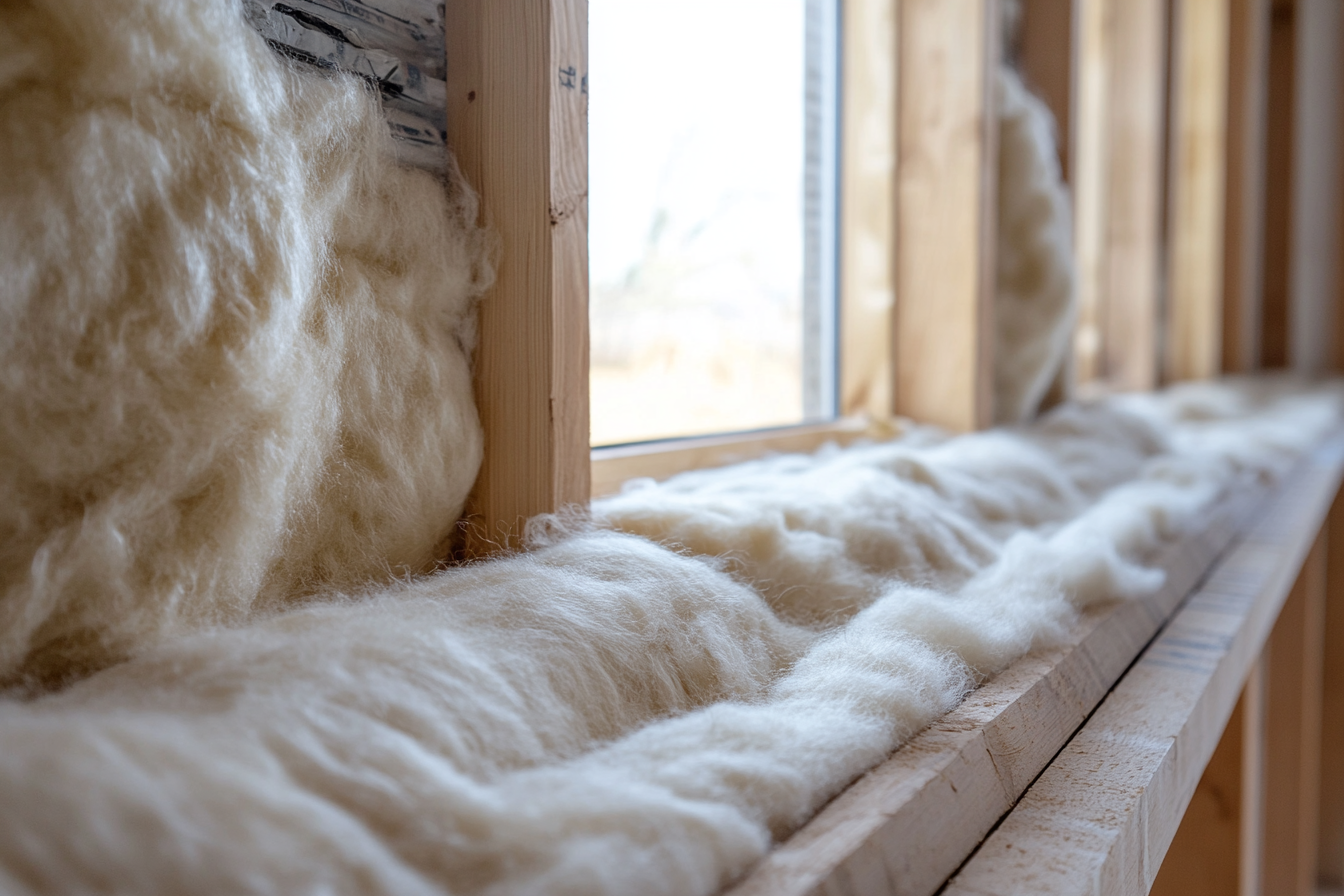
Wool fiber is a keratin protein with a complex internal structure: a cortex of long cells surrounded by overlapping scales, with a central medulla in coarser fibers. This structure gives wool its distinctive behavior with moisture. Wool can absorb up to 35 percent of its own weight in water vapor without feeling damp and without significant loss of insulating performance. The absorption is exothermic — wool releases a small amount of heat as it takes on moisture, and absorbs heat as it dries, producing a modest buffering effect on the temperature within the wall cavity.
The thermal conductivity of wool insulation is approximately 0.035 to 0.040 watts per meter-kelvin. The density, as installed, ranges from 15 to 25 kilograms per cubic meter for batts, higher for blown applications. Wool is treated with borax during processing — typically 5 to 8 percent by weight — which provides fire retardancy, insect resistance, and anti-fungal protection. Without treatment, wool is susceptible to moth larvae and will support mold growth if sustained moisture exceeds its buffering capacity. With treatment, it is durable and stable in service, maintaining its loft and thermal performance for decades provided the wall assembly remains reasonably dry.
Hemp and Flax
Hemp batt insulation is made from the bast fibers of the hemp stalk — the same plant that provides shiv for hempcrete, but a different part of it. The fibers are processed into flexible batts or semi-rigid boards, often blended with a small proportion of polyester binder fiber (typically 10 to 15 percent) to maintain shape. The thermal conductivity is approximately 0.038 to 0.042 watts per meter-kelvin, and the density ranges from 25 to 40 kilograms per cubic meter for batts.
Flax insulation is similar in form and performance — flax bast fibers processed into batts with a polyester binder. Both materials are hygroscopic, absorbing and releasing moisture vapor in response to changes in relative humidity, though neither buffers moisture as effectively as wool. Hemp and flax batts are treated with fire retardant — usually ammonium phosphate or borate — and are naturally resistant to mold and insect attack when kept within normal moisture levels. The fibers are robust in handling, do not irritate skin or lungs during installation, and cut cleanly with a knife.
Cellulose
Cellulose insulation is recycled paper — primarily newsprint — shredded and treated with borate compounds for fire retardancy and pest resistance. It is installed by blowing the loose fibers into wall cavities, attic spaces, and enclosed framing bays at a density of approximately 30 to 65 kilograms per cubic meter, depending on the application. The thermal conductivity is approximately 0.035 to 0.040 watts per meter-kelvin.
Cellulose is the most widely used natural insulation by volume. Its advantages are practical: it fills cavities completely, conforming to irregular framing and around obstructions where batt insulation leaves gaps. Its density, when blown to specification, resists air movement through the wall cavity — a significant factor in real-world thermal performance, because convective heat transfer through insulation voids often exceeds conductive losses through the insulation itself. Cellulose also provides effective sound attenuation — a wall insulated with dense-pack cellulose at 55 to 65 kilograms per cubic meter transmits noticeably less airborne sound than the same wall with fiberglass batts.
The material's vulnerability is sustained moisture. Cellulose absorbs water readily, and if the wall assembly allows bulk water to reach the insulation — through a leak, condensation on a cold surface, or inadequate vapor management — the cellulose will absorb it, lose its loft, and settle within the cavity. Settlement creates voids at the top of the wall where no insulation remains. Proper vapor management, air sealing, and weather barrier detailing are essential. The insulation itself will perform well for decades if the wall around it performs as designed.
Wood Fiber
Wood fiber insulation is made from softwood residues — sawmill waste and thinnings — processed into rigid or semi-rigid boards by wet or dry felting methods. The density is higher than other natural fiber insulations — typically 110 to 250 kilograms per cubic meter for rigid boards — which gives wood fiber a property that most insulations lack: thermal mass. A 60-millimeter wood fiber board has a thermal lag of approximately four to six hours — the time for a heat pulse on one face to register on the other. This is insignificant compared to a masonry wall but substantial for an insulation product. In a lightweight framed wall, wood fiber boards provide not only insulation but also a degree of thermal damping, smoothing the peaks of exterior temperature cycles before they reach the interior.
The thermal conductivity of wood fiber boards ranges from 0.038 to 0.050 watts per meter-kelvin, depending on density. The higher density boards are less insulating per unit thickness but provide better acoustic performance and greater rigidity, allowing them to serve as external sheathing or sarking boards that replace oriented strand board in the wall buildup. Wood fiber is hygroscopic — it absorbs and releases moisture vapor readily, with a moisture buffering capacity that helps regulate humidity within the wall assembly. The boards are treated with ammonium phosphate or other fire retardants and will char rather than flame in a fire, providing a degree of fire resistance beyond what their organic composition might suggest.
What They Ask
Natural fiber insulations share a set of requirements that follow from their organic origin. They must be kept from sustained wetting — not from temporary humidity, which most of them buffer effectively, but from bulk water or persistent condensation that exceeds their capacity to absorb and release. They require vapor management appropriate to the climate and the wall assembly — vapor-open construction that allows moisture to migrate and evaporate rather than accumulate. And they require fire retardant treatment, because untreated plant and animal fibers are combustible in a way that mineral and glass fibers are not.
The performance is comparable to synthetic alternatives in thermal resistance, superior in moisture buffering, and effective in acoustic attenuation. When service life ends, the fibers decompose — returning to the soil from which they were grown. Foam, fiberglass, and mineral wool do not offer this. The fibers were grown, and what was grown can decompose. The duration of their service is determined not by the material's inherent lifespan but by the condition of the assembly that surrounds them.