Materials with High Thermal Mass
The temperature outside a building changes continuously. Sunrise brings warming; sunset brings cooling; clouds, wind, and season impose their own rhythms on the cycle. The temperature inside a building with walls of high thermal mass changes more slowly, with a narrower range, peaking hours after the exterior peak and reaching its minimum hours after the exterior minimum. The walls do not generate heat or remove it. They delay it — absorbing energy when the surroundings are warm, releasing it when the surroundings cool — and in the delay, the extremes are softened into something more constant.
The Physics of Thermal Mass
Thermal mass is the product of three material properties: density, specific heat capacity, and volume. Density determines how much material is present per unit of space. Specific heat capacity determines how much energy that material can absorb per kilogram per degree of temperature change. Volume determines the total quantity of material available to participate in the exchange. A material with high thermal mass is dense, has a high specific heat, and is present in sufficient quantity to absorb a meaningful fraction of the daily heat load.
Thermal conductivity — the rate at which heat moves through the material — governs the speed of the exchange. A material with high conductivity absorbs heat quickly from its warm face and delivers it quickly to its cool face. A material with low conductivity absorbs slowly and delivers slowly. For thermal mass to function effectively in a wall, the conductivity must be high enough to allow heat to penetrate the full thickness during the warm period but low enough to prevent it from passing through entirely before the cycle reverses. The ideal is a material that fills with heat during the day and empties at night — a complete charge-discharge cycle synchronized to the diurnal temperature swing.
The time delay between the temperature peak on the exterior surface and the temperature peak on the interior surface is called thermal lag. For a 300-millimeter concrete wall, the lag is approximately six to eight hours. For a 450-millimeter rammed earth wall, it is eight to ten hours. For a 600-millimeter stone wall, it can exceed twelve hours. These numbers depend on the specific material properties and the boundary conditions on each face, but the pattern is consistent: thicker, denser walls produce longer delays, shifting more of the exterior heat cycle into the opposite phase of the interior day.
Concrete
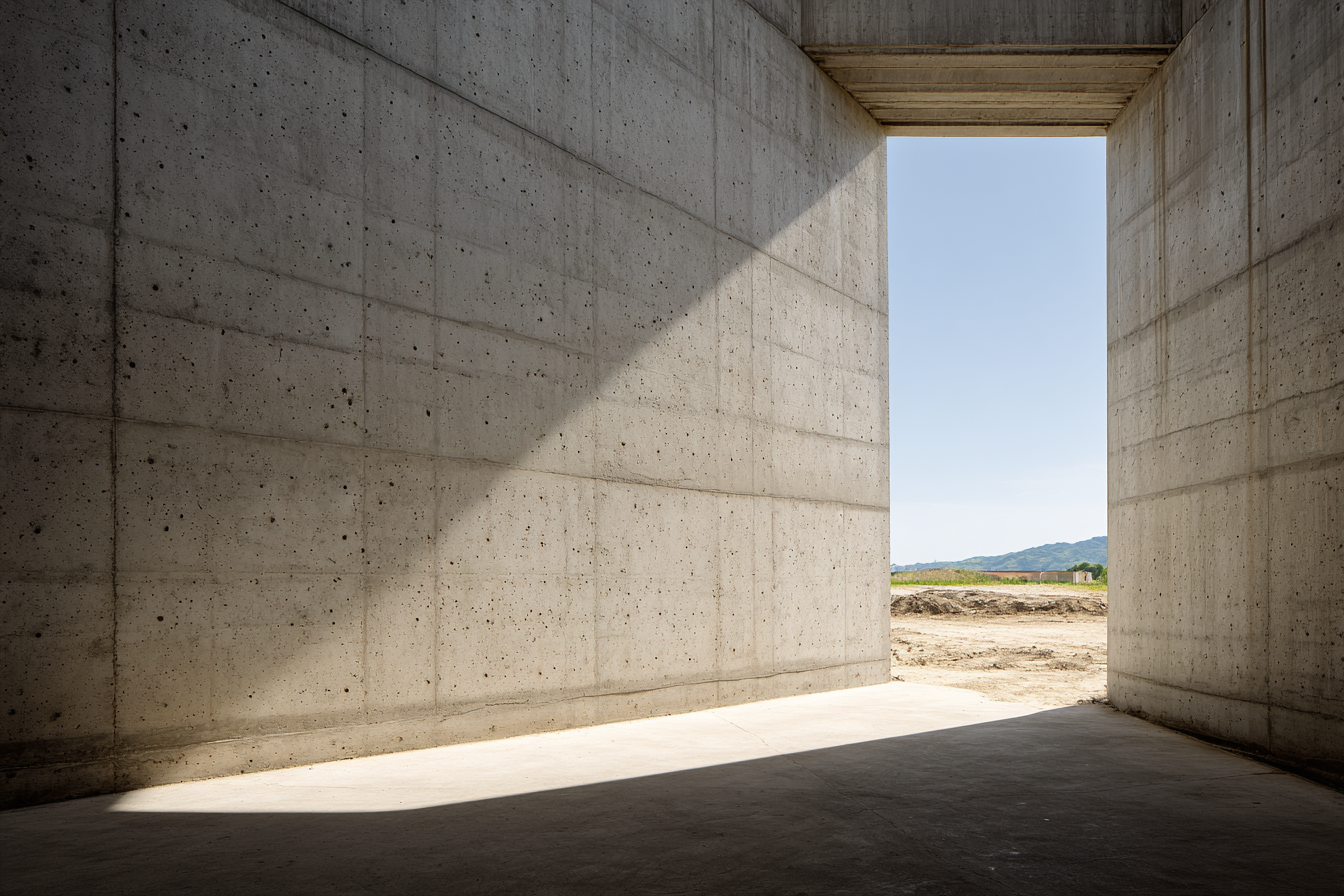
Concrete has a density of approximately 2,300 kilograms per cubic meter and a specific heat capacity of roughly 880 joules per kilogram-kelvin. Its thermal conductivity is between 1.0 and 1.8 watts per meter-kelvin depending on aggregate type and mix proportions. These values make concrete one of the most effective thermal mass materials in common structural use — dense enough to store significant energy, conductive enough to absorb it within the time frame of a diurnal cycle, and cheap enough to deploy in the volumes required.
A 200-millimeter concrete floor slab exposed to direct solar gain through south-facing glazing can absorb approximately 100 to 150 watt-hours per square meter over the course of a sunny winter day. This energy is released through the evening and night as the interior cools, reducing the demand on supplemental heating systems by a margin that depends on the insulation of the envelope, the area of exposed mass, and the outdoor temperature. The slab does not need to be heated to a high temperature — a rise of two to three degrees Celsius across its surface is sufficient to store the energy. The storage is invisible. The surface is marginally warmer than the surrounding air, and that margin is the mechanism.
Brick
Fired clay brick has a density of 1,600 to 2,000 kilograms per cubic meter, a specific heat capacity of approximately 800 joules per kilogram-kelvin, and a thermal conductivity of 0.6 to 1.0 watts per meter-kelvin. Its thermal mass per unit volume is somewhat lower than concrete, but its lower conductivity produces longer thermal lag per unit thickness — a 230-millimeter brick wall may achieve a lag of five to six hours, comparable to a thicker concrete wall.
The advantage of brick as a thermal mass material is its combined structural and thermal function. A load-bearing brick wall carries vertical loads, resists lateral forces, provides fire separation, and moderates the interior temperature simultaneously. It requires no additional structure and, if detailed with appropriate weathering protection, no additional cladding. The material serves multiple purposes in a single element, and its maintenance requirement — repointing of mortar joints on a cycle of fifty to eighty years, depending on exposure — is modest relative to its service life.
Brick walls that were laid centuries ago continue to perform their thermal function without measurable degradation. The specific heat of fired clay does not change with age. The density does not diminish. The thermal lag of a wall built in 1650 is the same as the thermal lag of an identical wall built today, provided the masonry is sound and the mortar joints intact. The material's thermal performance is a property of its composition, not its history.
Stone
Natural stone varies more widely in its thermal properties than any other common masonry material. Granite, with a density of approximately 2,700 kilograms per cubic meter and a thermal conductivity of 2.5 to 3.5 watts per meter-kelvin, absorbs heat rapidly and stores it densely but transmits it through the wall section relatively quickly. Limestone, at a density of 2,200 to 2,600 kilograms per cubic meter and a conductivity of 1.0 to 1.5 watts per meter-kelvin, stores nearly as much energy but delivers it more slowly. Sandstone, marble, slate — each occupies a different position in the matrix of density, conductivity, and specific heat, and each produces a different thermal lag and a different interior temperature profile.
The thickness of traditional stone walls — commonly 450 to 900 millimeters in older construction — provides thermal lag values that can exceed half a day. A massive stone building in a climate with significant diurnal temperature swings maintains an interior that is remarkably stable: cool in summer, not from insulation but from the sheer inertia of the mass; warm in winter evenings from the solar gain absorbed through the day. The stability is not perfect and not sufficient in extreme climates without supplemental systems, but it is real, and it is achieved without any mechanism more complex than a thick wall made of heavy material.
Rammed Earth
Rammed earth — compacted soil stabilized with a small percentage of cement or lime — has a density of 1,700 to 2,200 kilograms per cubic meter, a specific heat capacity of approximately 900 joules per kilogram-kelvin, and a thermal conductivity of 0.7 to 1.3 watts per meter-kelvin. At the wall thicknesses typically employed in rammed earth construction — 300 to 600 millimeters — the thermal lag ranges from six to twelve hours, and the temperature amplitude on the interior surface is a fraction of the exterior swing.
In arid climates with diurnal temperature ranges of 20 to 30 degrees Celsius, a well-oriented rammed earth building can maintain interior temperature fluctuations of less than five degrees without mechanical assistance. The mass absorbs the midday heat through the exterior face and delivers it to the interior well after sunset, when it is useful rather than burdensome. By morning, the wall has cooled sufficiently to begin the cycle again. The mechanism is entirely passive — no controls, no moving parts, no energy input beyond what the sun and the air provide.
Water
Water has the highest specific heat capacity of any common building material — approximately 4,186 joules per kilogram-kelvin, roughly four to five times that of concrete or stone. A cubic meter of water stores more thermal energy per degree of temperature change than a cubic meter of any masonry material. Its limitation is that it must be contained, and the container adds complexity, weight, and potential failure modes that solid mass materials do not possess.
Water walls — tanks or tubes filled with water and placed to receive direct solar radiation — have been used in passive solar design as high-capacity thermal storage. A 200-liter drum of water exposed to winter sun through south-facing glass absorbs and stores energy with an efficiency that would require approximately half a cubic meter of concrete to match. The water remains liquid throughout the operating range, eliminating any concern about phase transitions or structural behavior. It stores energy by getting warmer, and it releases energy by getting cooler, and the cycle repeats without degradation for as long as the container holds.
The Slow Negotiation
A building with high thermal mass does not respond quickly to changes in its environment. This is its limitation and its virtue. It cannot be heated rapidly — the mass absorbs the input and distributes it through its volume rather than concentrating it at the surface. It cannot be cooled rapidly for the same reason. It reaches its interior peak hours after the exterior peak and its interior minimum hours after the exterior minimum, and the gap between them — the amplitude of the interior swing — is always less than the amplitude outside.
This slowness is a form of stability. The building's interior temperature exists in a delayed, attenuated relationship with the exterior, mediated by hundreds or thousands of kilograms of dense material that must be heated or cooled before the interior conditions can change. The greater the mass, the slower the response, and the more closely the interior temperature approximates a constant. What the mass provides is not warmth or coolness in themselves but resistance to change — a material inertia that holds the interior condition steady while the exterior varies around it.