Maintenance
A building maintained across decades does not look maintained. It looks as though it was always this way—the stone clean, the timber oiled, the mortar flush with the joint. The work disappears into the result. This is the gift of attention sustained over time: the appearance of inevitability.
The Rhythm of Attention
Maintenance is not a single intervention or a dramatic repair. It is a pattern of regular observation woven through the seasons. Spring, arriving with melted snow and soft ground, reveals what winter concealed. Gutters clogged with winter debris become apparent. Cracks in pointing where freeze-thaw cycles have loosened mortar show themselves. The slope of the roof visible now without snow tells whether drainage has settled unevenly. Spring inspection is detective work made possible by the season's honesty.
Summer brings a different kind of clarity. Heat opens movement. Caulk that failed silently expands and contracts, making its inadequacy audible when windows and doors move. Paint on south-facing surfaces shows where UV has degraded the film. The slow growth of moss and lichen on shaded surfaces tells the story of moisture that has not dried between rains. Summer is the season of visibility, when the building speaks plainly about what it needs.
Autumn demands forward thinking. The heating systems that cooled all summer must be prepared for work. Gutters, having accumulated the shed leaves of fall, need clearing before they become channels for ice. The thermal envelope—insulation, windows, seals—must be verified complete before cold weather presses on every small gap. Autumn is the season of readiness.
Winter tests what has been prepared. If the work was done well, the building stands quiet. If there are gaps in attention, winter exposes them with urgency. A poorly sealed window frame allows cold air infiltration. An uncleared gutter channels water into freeze-thaw damage. Inadequate attic ventilation creates ice dams. Winter is judgment rendered by the season itself.
Reading the Surface
The surface of a building is not decoration. It is the building's autobiography, written in changes that have an internal logic once learned. Discoloration is not merely a matter of cleaning. A water stain on a ceiling follows gravity and drainage, marking the path of water from its entry point above to where it collects and betrays itself. Following that stain upward through the structure reveals not just where water entered, but which surface—roof, flashing, joint, penetration—failed first. The pattern teaches diagnosis.
Cracks tell their own stories through their language. A fine hairline crack in plaster or paint running vertically down a wall is usually cosmetic settling and requires nothing but attention. A pattern of cracks radiating from a corner, or cracks appearing suddenly after a season of heavy rain, speaks of structural movement or water infiltration that demands investigation. Diagonal cracks in masonry at forty-five degrees often mark points of structural stress that have been building over years. Horizontal cracks in mortar beds suggest water behind the facade or, if at the foundation, frost action or differential settlement. Each geometry has a cause, and causes compound if unattended.
Biological growth—moss, lichen, algae—appears where moisture stays longest. It is not failure, but it is a sign. Algae growth on a roof's north face is expected; it follows shade and moisture patterns. But algae on a south-facing wall, where it should dry between rains, suggests either poor drainage or ventilation, or both. Moss thick enough to hold visible moisture speaks of a surface condition—perhaps failed sealant, perhaps a crack in mortar—that needs addressing before the moisture penetrates deeper.
Efflorescence—the white powdery deposits that appear on masonry—is salts migrating through the material as water moves. It appears when water is moving through masonry from inside to outside. It is a tracer, showing the path of moisture and suggesting either interior dampness or exterior water infiltration working inward. It is not failure, but it is urgent information. Left alone, the salts continue their journey inward, potentially damaging the mortar from within.
Repair and Replacement
The tendency toward replacement is strong — it appears simpler, more decisive. But maintenance often means choosing repair. The distinction is not aesthetic. It is practical.
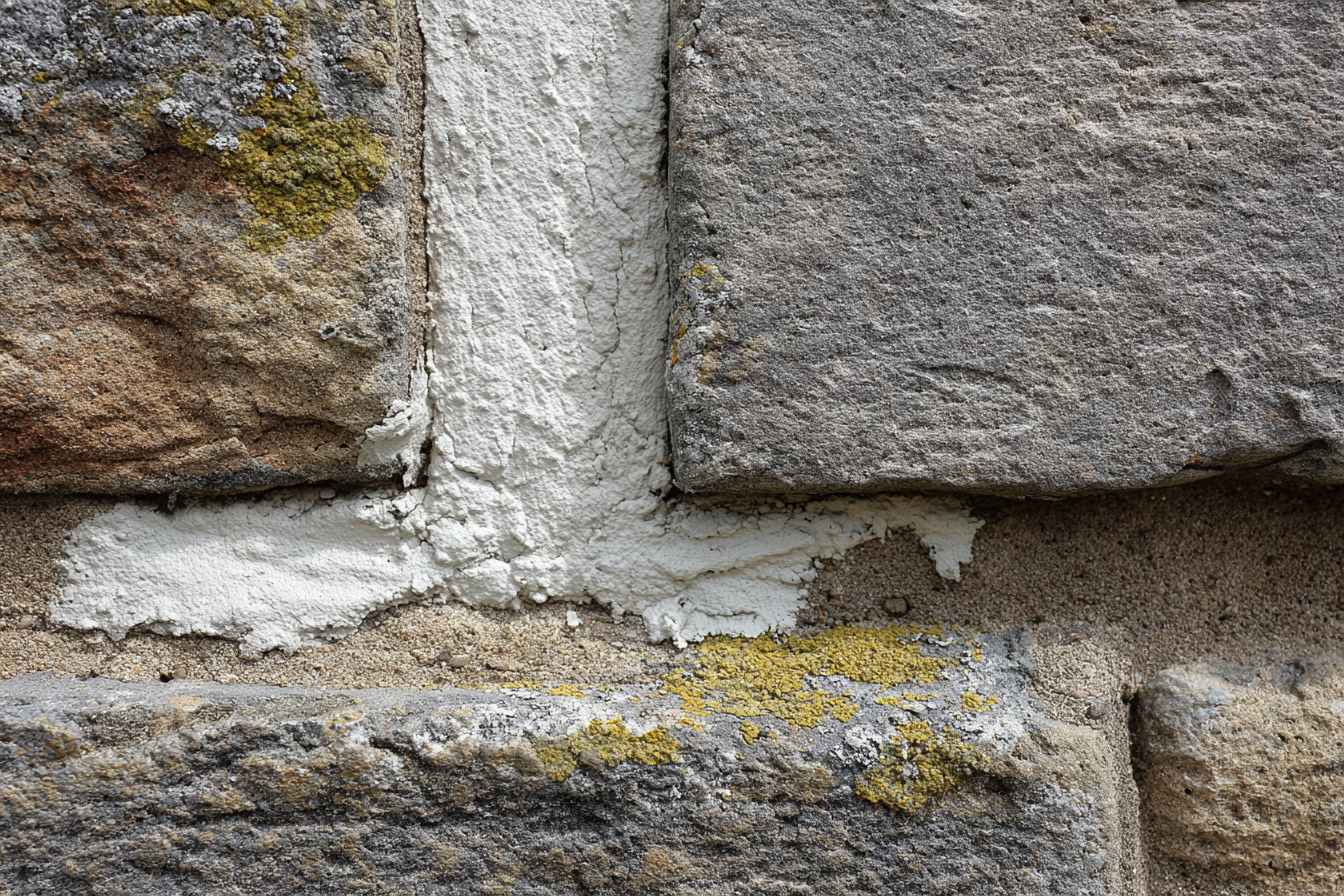
Repair targets the failure itself. When a section of mortar has failed, careful repointing removes the failed mortar and replaces it with new mortar that matches the original in composition, texture, and appearance. The material is chosen to perform its specific role: lime mortar for soft stone, because it is sacrificial and will fail first before damage reaches the stone; strong mortar for brick, because brick can withstand more rigorous bonds. The repair is specific to context.
Replacement, by contrast, removes and substitutes the entire assembly. It is necessary sometimes—when the underlying structure is truly compromised, when the material is no longer available or repairable, when damage is catastrophic. But replacement also erases information. It removes the weathered surface that tells time. It removes the subtle variations that came with age. It replaces performance-tested material with new material that has never been tested in that context. A window frame replaced wholesale is new and therefore untested. A window frame carefully repaired around new glazing and hardware maintains the seasoned wood that has already proven its durability.
Small interventions prevent the need for large ones. Caulk a joint before water enters. Seal a crack before ice widens it. Repoint mortar before moisture penetrates to the structural mass. Replace a damaged flashing before rust spreads. These are the small decisions, made regularly and without drama, that prevent the cascade from beginning. This is the true work of maintenance: the prevention of the need for repair.
Water: The Central System
Water is the single most destructive force on a building. It freezes and expands. It carries salts that migrate through materials. It rots wood, rusts steel, and weakens mortar. It feeds the biological growth that breaks down surfaces. More damage over time flows from uncontrolled water than from any other cause. Therefore, drainage is the most consequential system to maintain.
Gutters and downspouts are not decorative. They are the first line of defense, managing water shed from the roof and directing it away from the foundation. A clogged gutter is not a small problem. It is water running outside the intended path. That water may enter the wall at the roofline, or cascade against the foundation, or flow along the fascia and rot it from inside. Regular clearing of gutters—ideally in spring after winter weathering and again in autumn after leaf fall—is not optional maintenance. It is foundational.
Grading around the building is equally consequential. Soil that slopes toward the foundation channels water toward the structure instead of away from it. Over years, this constant flow of water at the foundation wall leads to dampness in basements and crawlspaces, to efflorescence and salt damage, to deterioration of foundation mortar. Simple grading work, resloping soil to create a gentle slope away from the building, can eliminate years of moisture problems. The work is cheap compared to the cost of unaddressed water infiltration.
Flashing—the thin material at intersections and penetrations where water naturally wants to collect—must be continuous and properly overlapped. A single gap in flashing can channel water into the structure for years before the damage becomes visible inside. Flashing is often hidden, which is precisely why it demands regular attention. It cannot be assumed to be good; it must be verified. Ice dams, where snow melt refreezes at the eave, are prevented by adequate ventilation and insulation; if they form, they force water back up under shingles where it can penetrate the structure. Managing water, from its arrival on the roof to its final drainage away from the building, is the primary work of durable maintenance.
The Accumulation of Time
Deferred maintenance does not stay deferred. A small problem—a crack in pointing, a missing roof fastener, a clogged downspout—left unaddressed through one season becomes two problems by the next. Water enters through the crack, freezes, widening it. The loose roof fastener allows a shingle to lift; wind lifts more; the water infiltration begins. The clogged downspout sends water against the foundation; that water finds a path into the basement; efflorescence appears; the mortar begins to degrade.
Over years, small deferrals compound. The cost of addressing five small problems is a fraction of the cost of addressing the cascade they trigger. The building that becomes expensive to maintain is often not one that was poorly built; it is one that was neglected in small ways, allowed to accumulate damage unaddressed, until the damage reaches structural depth and becomes urgent and costly.
This is why the rhythm of seasonal inspection is not luxury. It is practical economy. The attention that learns to read a building—that knows what the cracks mean, what the stains suggest, what the growth indicates—can intervene before cascades begin. The small repair, applying mortar or sealant or oil at the right moment, prevents the large repair from becoming necessary. The toolkit is simple: lime mortar, linseed oil, natural caulk, beeswax, careful pointing tools, and patience. But the results accumulate. A building tended in this way, across decades, quietly demonstrates the paradox: it appears effortless because the work has been constant.