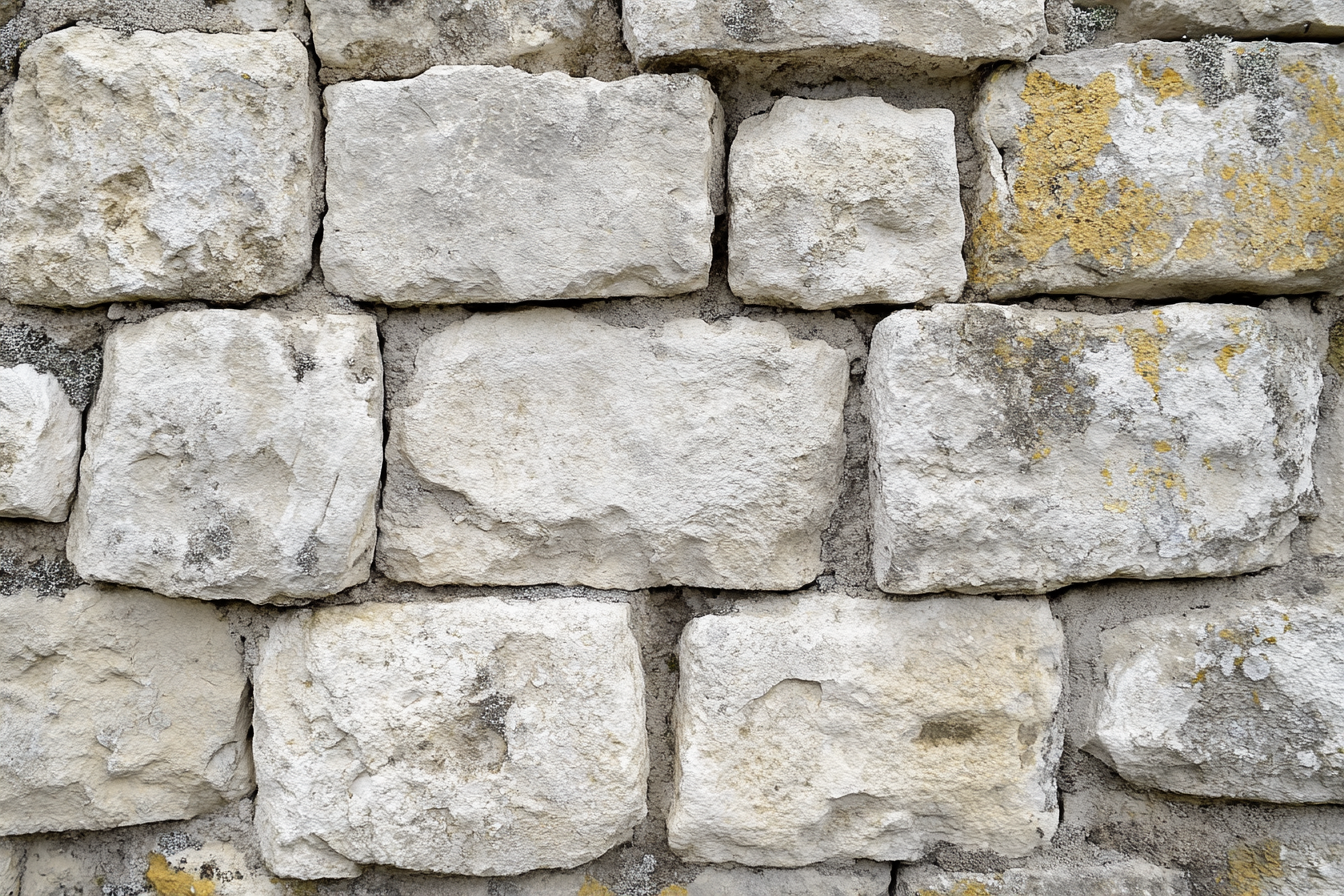
Lime Mortar
Lime mortar does not set in the way that cement sets. It carbonates — absorbing carbon dioxide from the air and slowly reverting to the limestone from which it was made. The process takes weeks, months, sometimes years. The mortar does not care. It has been doing this for longer than any other manufactured building material has existed.
The chemistry is elegant in its simplicity. Limestone — calcium carbonate — is heated in a kiln to approximately 900 degrees Celsius. The heat drives off carbon dioxide, leaving calcium oxide: quicklime. The quicklime is slaked with water, producing calcium hydroxide: a soft, plastic putty that can be mixed with sand to produce mortar. When this mortar is placed in a joint and exposed to air, it absorbs carbon dioxide and gradually converts back to calcium carbonate — the same substance it began as. The cycle is closed. The carbon released in firing is recaptured in setting. The mortar returns to stone.
This is non-hydraulic lime — the simplest form, and the one that has been in use for at least seven thousand years. It sets only in the presence of air and only at a rate determined by the diffusion of carbon dioxide into the mortar joint. A thick joint will carbonate from the surface inward, and the interior may not fully set for months. This pace is incompatible with modern construction schedules, which is why non-hydraulic lime was largely displaced by Portland cement in the nineteenth century. Cement sets in hours, reaches working strength in days, and does not require the patience that lime demands.
What Lime Does That Cement Cannot
The displacement of lime by cement solved the problem of speed and introduced a different set of problems. Portland cement mortar is rigid, impermeable, and strong in compression — properties that are advantageous in reinforced concrete but problematic in traditional masonry. A cement mortar joint does not flex with the wall; it locks the masonry units in place and transfers stress to the weakest point, which is usually the stone or brick itself. The result, in buildings with any capacity for movement — which is most buildings — is cracking: of the mortar, of the masonry units, or both.
Lime mortar flexes. Its compressive strength is lower than cement — typically 2 to 5 megapascals versus 20 to 40 for cement — but this is by design. The mortar is intended to be the sacrificial element in the wall: softer than the stone, willing to absorb movement and moisture without transmitting damage to the units it bonds. When a lime mortar joint cracks, the carbonation process can heal the crack over time as moisture carries dissolved calcium hydroxide into the gap and carbonation resumes. This self-healing capacity — autogenous healing, in the technical literature — is modest but real, and it occurs without intervention.
Lime mortar is also vapor-permeable. It allows moisture to migrate through the wall assembly and evaporate at the surface, rather than trapping it behind an impermeable barrier. In buildings without cavity walls or damp-proof membranes — which includes most structures built before the twentieth century — this permeability is essential. It allows the wall to manage moisture through evaporation rather than accumulation, preventing the conditions that lead to rising damp, salt crystallization, and freeze-thaw damage.
Hydraulic Lime
Not all lime is non-hydraulic. Natural hydraulic lime — produced from limestone that contains clay impurities — sets partly by reaction with water and partly by carbonation. The hydraulic component gives the mortar an initial set that is faster than pure air lime and allows it to harden in damp conditions where carbonation would be too slow. The trade-off is reduced flexibility and reduced vapor permeability compared to pure lime, though both properties remain superior to cement.
Natural hydraulic limes are graded by strength: NHL 2 (feebly hydraulic), NHL 3.5 (moderately hydraulic), and NHL 5 (eminently hydraulic). The grade is selected according to the exposure conditions and the hardness of the masonry units. A soft sandstone wall requires a soft mortar — NHL 2 or pure air lime. A hard engineering brick in an exposed location can tolerate NHL 5. Getting this match wrong — using a mortar that is harder than the masonry — is one of the most common and destructive errors in building conservation, and it is overwhelmingly the result of specifying cement where lime was needed.
Working With Lime
Lime mortar is unforgiving of inattention and generous with those who take the time to understand it. The mix must be prepared correctly: lime putty that has been matured for at least three months produces a mortar with better workability and durability than freshly slaked lime. The sand must be sharp, well-graded, and free of organic material. The proportions — typically one part lime to two and a half to three parts sand — must be consistent.
Application requires care. Lime mortar must not dry too quickly — rapid drying prevents carbonation and produces a weak, powdery surface. In hot weather, joints must be misted with water and protected from direct sun and wind. In cold weather, lime mortar must not be applied below 5 degrees Celsius, because ice formation disrupts the setting process. The material enforces a seasonal discipline on the work: lime pointing is done in spring and autumn, when temperatures are moderate and the air carries enough moisture to support carbonation without saturating the joint.
This is slow work. A skilled mason re-pointing a stone wall with lime mortar might complete three or four square meters in a day — cutting out the old mortar, preparing the joints, mixing and applying the new mortar, tooling the finish, and protecting the work from the weather. The pace is dictated by the material. Lime cannot be hurried, and the buildings that are maintained with it carry the evidence of that patience in their joints: even, well-carbonated, sympathetic to the stone, and likely to outlast the next intervention by decades.