Material Lifecycles
Every material that enters a building has traveled far before arriving at the site, and will travel further still after the structure is dismantled. To tend a building is to understand the deep cycle of extraction, transformation, service, and return that constitutes the true life of matter in the built environment.
Extraction: The First Disruption
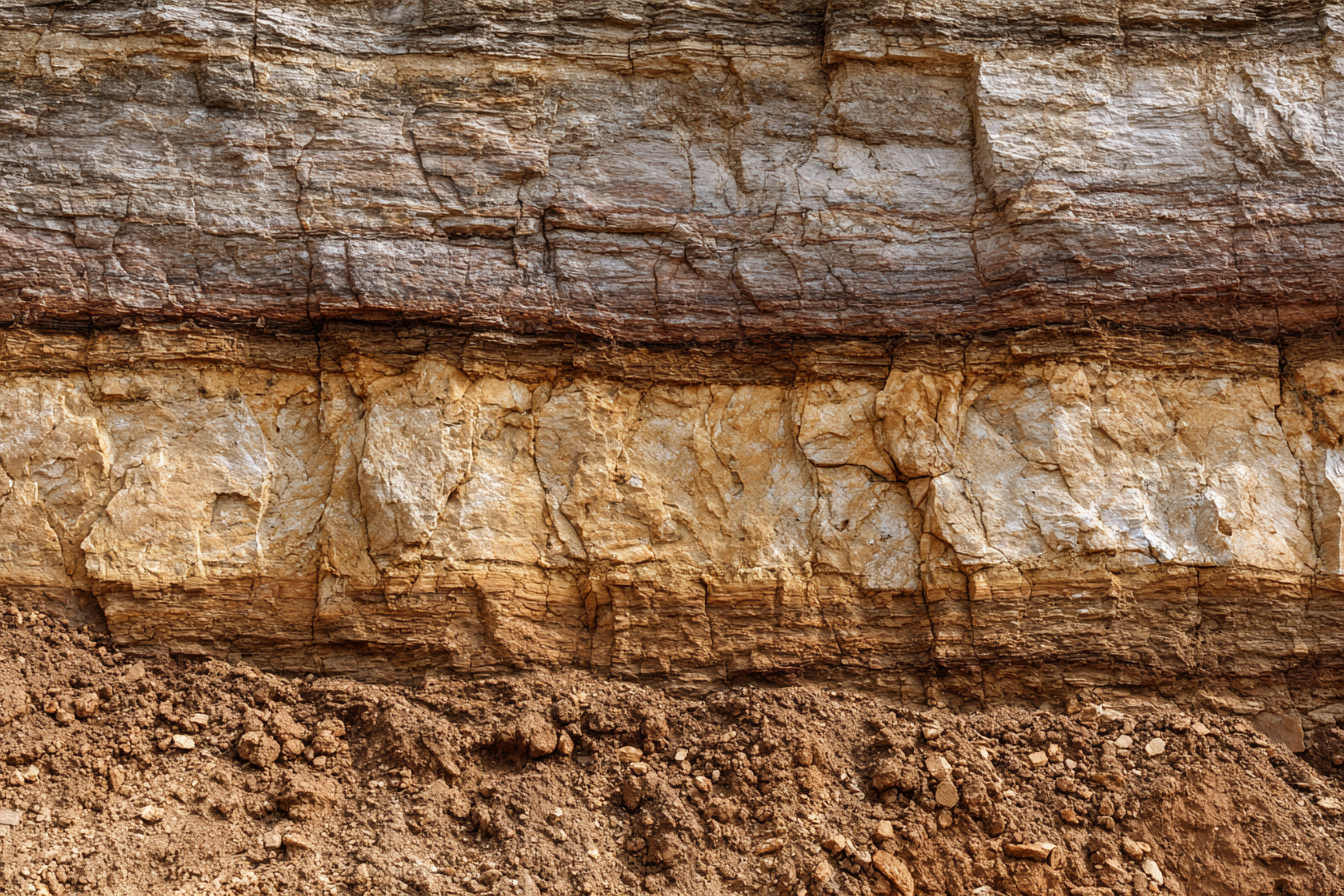
Materials begin as concentrations of useful minerals within the earth—ore, clay, stone, timber. Extraction removes them from equilibrium, breaking the geological context that held them stable for millions of years. A limestone formation that has been undisturbed for sixty million years is suddenly exposed to atmosphere and machinery. A forest that has been growing for two centuries is felled over weeks. The extraction process is radical and irreversible, yet it is the necessary precondition for all that follows.
The cost of extraction—in energy, in land disturbance, in water use—is real and material. Yet it is paid once, upfront. A ton of quarried stone will remain stable in that extracted state indefinitely. Unlike renewable resources that must be replanted or regrown, a mineral extracted today is an asset that can be held for decades or centuries before being put to use. This asymmetry between the acute disruption of extraction and the long persistence of the extracted material is foundational to understanding material economics.
Processing: Form and Permanence
Raw minerals become building materials through processing. Stone is cut to shape. Clay is fired into brick. Ore is smelted into metal. Timber is milled, dried, and graded. These transformations impose deliberate intention on matter—determining the dimensions, strength characteristics, and surface qualities that will govern how the material behaves in service.
Processing is where durability is either built in or compromised. A brick fired to the correct temperature will endure indefinitely; one underfired will fail within decades. A steel beam protected from moisture with adequate coating will serve for over a century; one exposed to salt spray may fail in twenty years. The processing stage is also where the material becomes fungible—a standardized product that can be shipped, stored, and integrated into structures months or years after manufacture.
Processing also represents the last point at which the material form is truly flexible. Once a brick is fired, its internal structure is set. Once concrete is cured, its strength is determined. The processing stage is brief—hours or days in most cases—yet its effects persist across the entire service life of the structure.
Service: Stability and Change Over Time
In service, materials occupy an unusual state. They are simultaneously inert and active. A stone wall standing in a building is essentially the same matter it was before installation—the same atomic structure, the same mineral composition. Yet it is not unchanging. It weathers. It absorbs moisture and sheds it with the seasons. It thermally expands and contracts. Over decades, surface degradation proceeds, grain by grain. Over centuries, the accumulated effect becomes visible.
Different materials weather at different rates. Granite resists weathering across multiple centuries, its granular structure remaining intact even as feldspar minerals slowly alter. Sandstone, softer and more permeable, shows visible erosion within decades. Brick can persist for centuries or fail within fifty years, depending entirely on clay quality and firing. Timber, if kept dry, can endure for five centuries or more; if exposed to moisture, it may fail in twenty years.
Service life is not passive. It is a continuous negotiation between the material and its environment. Rain percolates into joints and cracks. Freeze-thaw cycles in cold climates impose stresses. Chemical attack from salt, acid, or alkaline conditions proceeds slowly but relentlessly. Thermal movement creates stress at material interfaces. Structural loading concentrates in patterns that may cause localized failure. The material's ability to withstand these stresses depends not only on inherent strength but on how well it was protected at vulnerable points—joints, edges, interfaces with dissimilar materials.
Yet properly maintained, materials demonstrate remarkable longevity. A stone building can remain sound for four hundred years if water is shed correctly, if cracks are sealed before they propagate, if joints are repointed before they fail. Maintenance is not optional; it is the essential framework within which long service life becomes possible. A material left to its own devices will deteriorate faster than one that is tended.
Degradation and Failure Modes
All materials degrade. The question is not whether, but how and at what rate. Some degradation is visible and easily detected—spalling brick, rust staining, wood rot. Other degradation is hidden. Internal corrosion can proceed undetected within a steel beam until sudden failure occurs. Moisture damage within wall assemblies can be well-advanced before it becomes apparent on surfaces. Crystalline salt growth within porous materials weakens structure from within before visible efflorescence appears.
Common failure modes follow predictable patterns. Water is the primary vector of degradation in most climates—it carries dissolved substances that chemically attack minerals, it freezes and expands, it promotes biological growth, it enables corrosion. Thermal cycling stresses materials and their connections. Chemical attack—salt, pollution, soil acidity—proceeds along predictable kinetic pathways. Biological attack—growth of mosses, algae, lichens, fungi—indicates that conditions are favorable for these organisms and that water management is compromised.
The rate of degradation can be slowed or accelerated by maintenance decisions. A roof kept free of debris drains water efficiently; one allowed to retain moisture creates conditions for accelerated failure. A metal structure kept painted resists corrosion; one where paint fails progresses rapidly toward failure. A wood assembly kept dry remains sound indefinitely; one subject to chronic moisture degradation proceeds toward failure on a timeline of years to decades.
Recovery and Remanufacture
When a material's service life in one building ends, its material existence continues. Stone salvaged from a demolished structure can be incorporated into new construction or can return to quarried stone stockyards, potentially gaining a second or third service life. Brick can be cleaned and reused, losing nothing material in the process. Timber from old barns, often superior to modern growth, becomes valuable again in recovery architecture. Metal is infinitely recyclable; steel can be melted and reformed without degradation of properties.
Remanufacture is where the true utility of extraction is realized. The energy cost of extraction is paid once, but the material can be used, recovered, and reused multiple times across centuries. A ton of copper extracted two hundred years ago can still be in service, having cycled through plumbing systems, electrical infrastructure, and architectural details. Each cycle requires only the energy of collection, melting, and reforming—far less than the original extraction and smelting.
Not all materials recover equally. Some, like pure metals, are infinitely recyclable. Stone and brick, if not mixed with incompatible materials, can be separated and reused indefinitely. Wood can be re-milled if not chemically treated. Concrete, when mixed with dissimilar materials or chemically contaminated, is difficult to remanufacture at scale and typically downcycles into aggregate. Composite materials—materials bound or blended together—often cannot be economically separated for remanufacture.
Decomposition and Return
Some materials return to the environment through decomposition rather than recovery. Timber, if left to natural processes, slowly returns to the soil from which its constituent carbon was drawn. The process unfolds across decades as fungi and bacteria break down cellulose and lignin. The wood darkens, softens, loses structural integrity, and gradually becomes indistinguishable from humus.
This process is slow. A massive timber beam exposed to weather might require eighty to one hundred years to fully decompose. If the timber is kept from water, the decomposition nearly halts entirely—wooden structures have been found preserved in anaerobic conditions for over a thousand years, their lignin still intact. The pathway of decomposition is thus heavily dependent on environmental conditions maintained after the material's service life has ended.
Most mineral materials do not truly decompose. They weather and fragment, but the atoms remain. A quartzite building weathered to sand has not changed chemically—it has simply returned to a smaller grain size, ready to be reconsolidated by geological pressure over deep time. This too is a cycle, but one measured in millions of years rather than decades.
The Long View
To trace a building material across its full lifecycle is to recognize a profound truth: matter persists. The limestone that was quarried and shaped into a building stone existed for sixty million years before extraction. After two hundred years in service, it will exist for another sixty million years, in one form or another. Extraction and service are brief episodes in the material's actual lifetime.
The decisions made during processing and maintenance determine whether the material's service life is measured in decades or centuries. The decisions made at the end of service life determine whether the material returns to useful circulation or disperses into lower grades of utility. Over deep time, these decisions compound. A material recovered and reused extends the utility of the original extraction by another century. A material maintained prevents premature failure and loss of embodied value.
The architecture that endures is not the architecture that resists these cycles, but the architecture that acknowledges them. It uses materials appropriate to their expected service lives. It protects them from the primary degradation vectors. It facilitates their recovery at the end of service. It accepts that change and weathering are part of the material's nature, not failures to be prevented. This is the stance of those who tend buildings across long time—not to arrest time, but to manage the material cycles that give time its shape.