Landscape and Shelter
A tree planted today changes nothing about the building's thermal performance this year. In fifteen years it shades the western wall. In thirty it has reshaped the microclimate entirely. This is the slow mathematics of landscape as building system.
The Timescale of Living Systems
Most building systems are designed and installed within months. They age within years. But a landscape operates on a different calendar. A sapling planted in spring reaches useful shading height in a decade or more. An evergreen windbreak takes five to seven years to achieve the density needed to noticeably slow wind across a foundation. This temporal lag—between the planting decision and the thermal benefit—requires a willingness to invest in systems that may not reach maturity within a single generation. It is an act of confidence in the durability of the building itself.
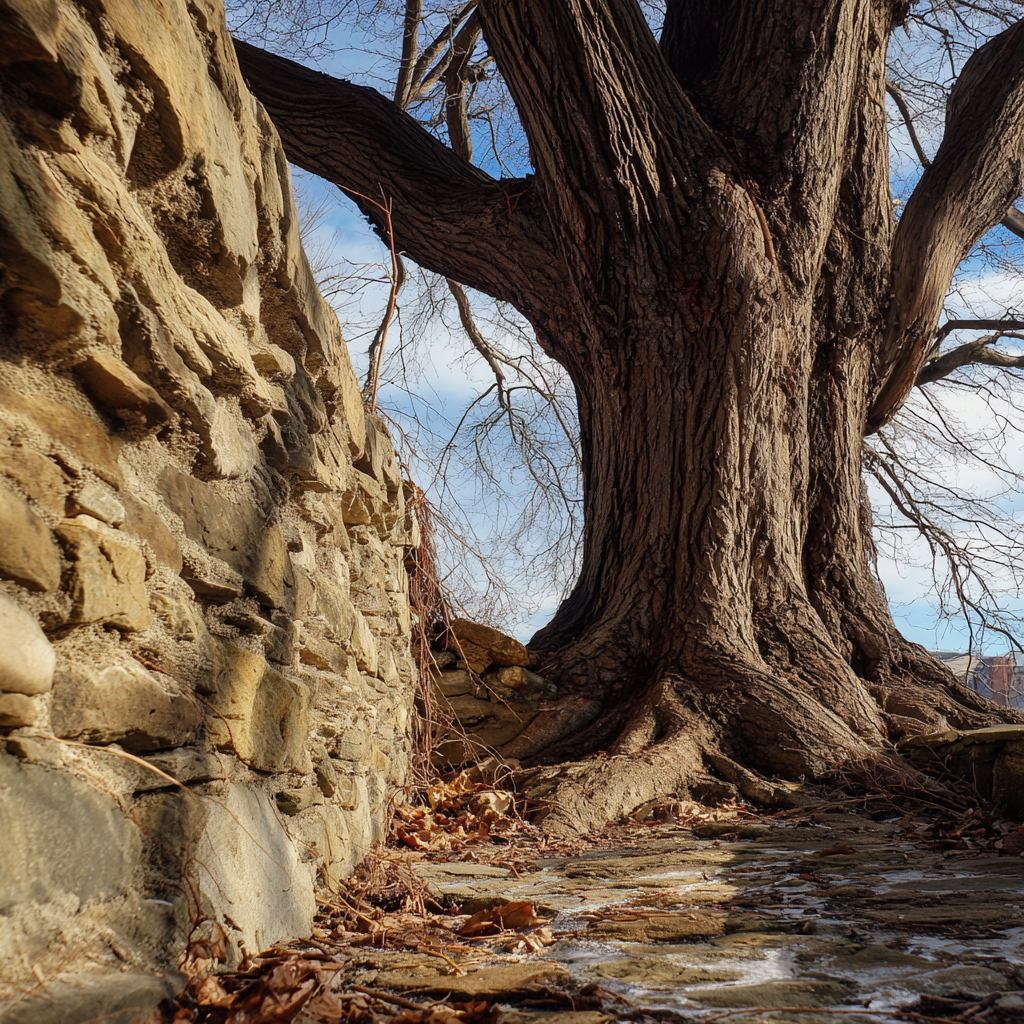
Trees outlast most construction. A roofing system fails in thirty years. An HVAC unit lasts twenty. A mature oak, properly established, remains for centuries, continuously reshaping the microclimate around a structure long after the planting itself has been forgotten. This persistence is the opposite of mechanical systems, which demand replacement and upgrade. A landscape, once established, deepens and compounds its effects over time.
The Deciduous Canopy as Living Overhang
A properly oriented deciduous tree functions as a responsive thermal device—bare in winter to allow the low sun to strike south and west-facing walls, then foliated in summer to block the high sun when interior cooling is needed. No overhang can adjust itself this way. An architectural shade structure is fixed; the sun's angle changes, but the structure does not. A tree responds to season, thickening and thinning in concert with solar intensity and ambient temperature.
The effect is not immediate. A young tree casts light shade. As it matures, the canopy spreads, the trunk thickens, the annual ring of growth adds volume and density to the crown. In year three, the shade might lower afternoon wall temperature by a few degrees. In year twelve, a mature maple or oak positioned on the western exposure can reduce solar load significantly—measurably reducing cooling demand on the hottest days of the year. The thermal benefit accumulates with growth.
This is fundamentally different from fixed shading, where external devices are calculated in advance and built to specification. Landscape requires accepting that the first decade will deliver incomplete thermal performance, with the understanding that the second and third decades will compound the benefit.
Windbreaks and the Reshaping of Air Movement
Wind is thermal loss. A building on open ground loses heat from every surface exposed to wind. The addition of a windbreak—a line of evergreens positioned north or upwind—doesn't merely dampen wind speed; it fundamentally restructures the flow pattern around the structure. Where wind once approached at full velocity, it now encounters decreasing resistance. The boundary layer deepens. The building is no longer in the open wind field but in the wind shadow of the vegetation.
The geometry matters considerably. Evergreens planted in a solid line create a dead zone immediately behind them—sometimes too still, air pooling rather than flowing. A windbreak with some porosity, with gaps that allow air through but slow it, creates a more useful reduction. Dense at the outer edge, more open toward the protected side. The width of the protected zone extends roughly two to five times the height of the trees. A windbreak of trees thirty feet tall creates useful wind protection fifty to one hundred fifty feet downwind.
What's observable is the change in microclimate around the building in winter. On a cold, windy day, the sheltered side is noticeably less harsh. Snow doesn't accumulate as heavily near the foundation on the protected side. In summer, paradoxically, the same windbreak can channel cooling breezes in useful directions if oriented correctly. The structure becomes more responsive to season, less brutally exposed to prevailing conditions year-round.
Evapotranspiration and the Cooling of Air
On a hot day, the air temperature in and near living vegetation is measurably cooler than in bare surroundings. This isn't psychological. Plants release water through their leaves—evapotranspiration—and this phase change absorbs heat from the surrounding air. The effect is strongest when vegetation is adjacent to air inlets or windows, where cooled air can enter the building's thermal envelope.
A well-planted ground-level garden around a building's perimeter changes the temperature of air moving across it. The effect is subtle in dry climates, more pronounced in humid ones with adequate water. But over a full summer season, the accumulated effect of slightly cooler inlet air reduces cooling load measurably. This is why buildings in hot climates with mature vegetation around them run cooler than identical structures on barren sites.
Water features compound this effect. A pond or channel located to catch prevailing breezes before air reaches the building creates an intermediate cooling zone. The evaporation from open water accelerates the phase change, further cooling the air. The placement matters—downwind of the building is useless; positioned to cool air before it enters, the benefit is real. But this too requires maintenance, long-term attention, and the willingness to sacrifice ground area that could be built upon or paved over.
Roots and Foundations: The Proximity Question
A practical constraint emerges in most climates: the relationship between tree root systems and building foundations. Trees planted too close damage foundations. Root systems, seeking moisture, seek also the interface between soil and concrete—they penetrate cracks, expand joints, disrupt the seal. The closer the tree, the more aggressive the root system becomes in pursuing that subterranean moisture gradient.
Conversely, trees planted too far provide insufficient benefit. A tree fifty feet away shades almost no useful area. The balance is found in the middle ground: far enough to avoid foundation damage, close enough to provide meaningful thermal effect. For most species, this means fifteen to twenty-five feet from the building face, depending on tree species, soil moisture, and the style of foundation construction.
The constraint tightens on smaller properties, where the geometric relationship between useful shade placement and safe distance creates difficult tradeoffs. A tree large enough to shade a western wall faces may require placement thirty feet away. A property forty feet wide offers limited options. The landscape design becomes a negotiation between thermal benefit, structural safety, and the space available to achieve either.
This is where understanding the behavior of different species becomes crucial. Shallow-rooted trees like birches and most maples are less aggressive at foundations than deep-rooted species like oaks. On properties with tight constraints, the choice of species directly determines what proximity is safe, and therefore what thermal benefit is achievable.
Ground Cover and the Temperature of Soil
Bare soil absorbs solar radiation and radiates heat. Ground covered with plants—grass, ground cover, mulch—stays cooler and more stable in temperature. This affects the temperature of air immediately at ground level, the microclimate of the lowest boundary layer around the building. It's a subtle effect, but across a full growing season, a planted ground versus a paved or bare one shows measurable difference in ambient temperature.
The root systems of ground cover modify soil structure, increasing porosity and water retention. Cooler, more stable soil means less heat transfer into the building through below-grade surfaces. The effect is modest compared to shade or windbreaks, but it's constant and cumulative. Where landscaping is dense around a building's footprint, the temperature gradient from exterior soil to interior foundation is less steep than it would be on barren ground.
In arid regions, this takes on added importance. Ground cover that survives without excessive irrigation reduces the thermal load of water maintenance. Rock mulches, while reflective, don't have the evaporative cooling effect of living vegetation. The choice between aesthetic preferences, maintenance demands, and thermal performance becomes consequential.
The Patience Required
Landscape as thermal strategy asks for patience. It asks acceptance that the first ten years will be incomplete, that full benefit will not arrive in a single growing season or even a single decade. It asks trust that the sapling planted today will mature into something useful, and that the building, properly built, will stand long enough to benefit from that maturation.
This runs counter to contemporary construction logic, where systems are designed, installed, and tested for immediate performance. Landscaping requires planning for a building's performance across generations. It is not a calculation that appears on performance ratings. But over decades, the cumulative thermal effect of mature vegetation around a structure is as significant as many of the mechanical systems built into it. It is simply expressed on a longer timeline — one measured in tree ages rather than system lifespans.