Insulation and Thermal Mass
In the middle of August, a stone building stays cool long after the sun has stopped bearing on its walls. In the middle of January, it takes days for that same mass to warm up once a heating source is lit. Across the driveway, a well-insulated timber frame building heats quickly in winter and cools quickly in summer, its temperature swinging wider and faster in response to the weather and the sun. These are two fundamentally different thermal arguments, and buildings that have committed to one or the other reveal that choice in how they feel across a full year of seasons.
Resistance and Storage
The architectural divide between insulation and thermal mass is a divide between resistance and storage. Insulation resists the flow of heat; it slows down the exchange between inside and outside. Thermal mass absorbs heat, holds it, and releases it gradually—it smooths out the spikes and dips of temperature that would otherwise occur. Both strategies reduce the energy needed to keep a building thermally stable, but they accomplish this in opposite ways. A building well-insulated but light in mass will respond quickly to the sun or a cold snap. A building dense with thermal mass but not well-insulated will fluctuate widely, its interior temperature swinging with the outdoor conditions but moderated by the slow movement of heat through its fabric.
Neither strategy exists in isolation in any real building. The question is never insulation or thermal mass; it is always which takes the lead, and how much of each is enough. Over time, the choice made at the beginning—often unknowingly—shapes how the building performs across the seasons and how it feels to be inside it.
The Thermal Lag of Stone
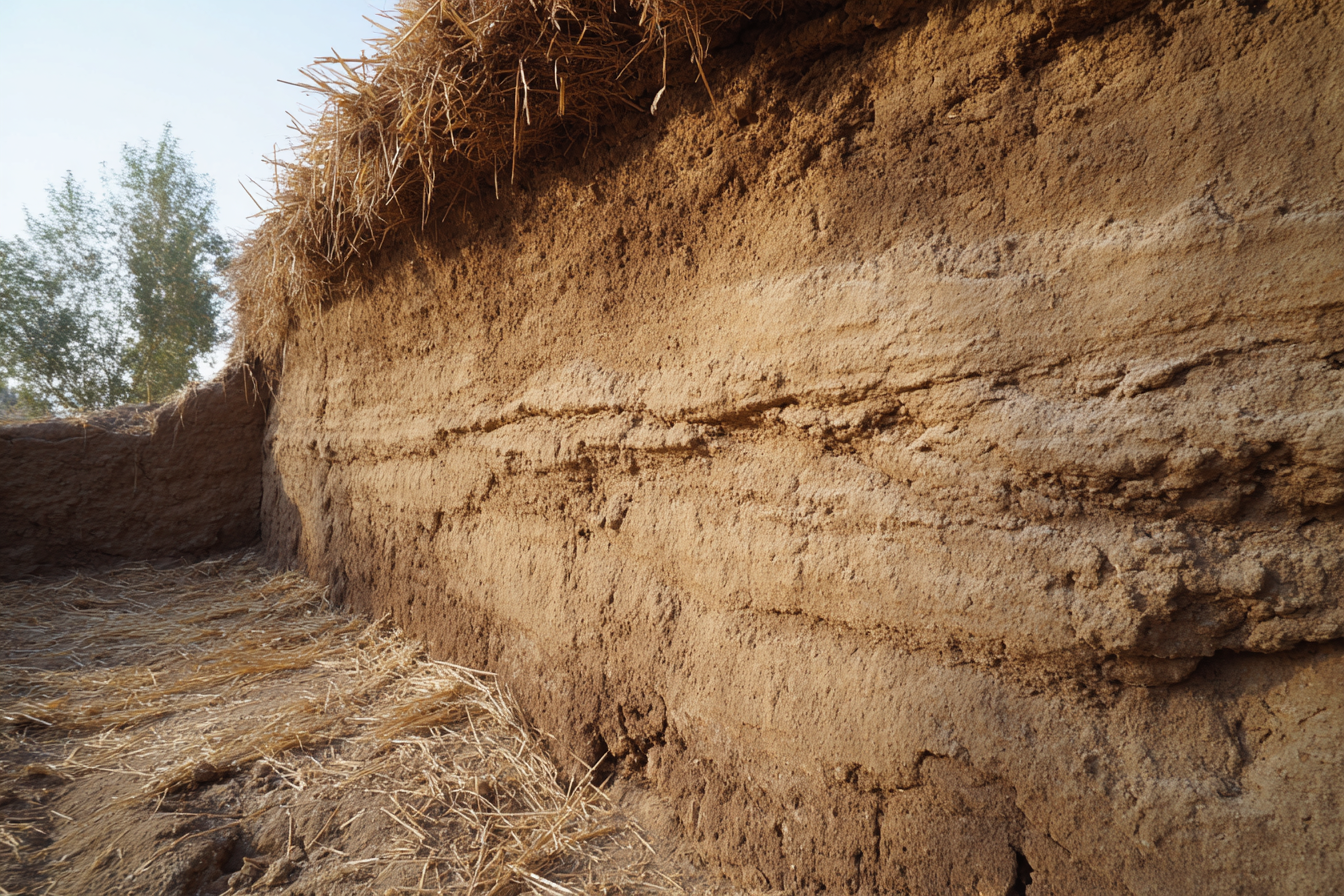
A stone or masonry building in summer demonstrates thermal lag in observable form. Heat reaches the exterior wall by midmorning. That wall, exposed to the sun, grows warm, but the interior surface remains cool because the heat must travel through the thickness of the stone. By the time the afternoon heat reaches its peak, the interior of the building is still benefiting from the cool stored in the mass—the coolness absorbed overnight or held over from previous days. Only in evening does that wall begin to release the heat it has accumulated. The stone radiates warmth from its surface. The interior stays cool long into the night.
This thermal lag is not subtle. A well-built masonry wall can take eight to twelve hours for external heat to travel through to the interior. The building interior stays many degrees cooler than the outdoor air during the hottest part of the day. It is only as the sun sets and the exterior begins to cool that the interior catches up. This is thermal equilibrium that costs nothing in summer, bought through the simple mass of the walls themselves.
In winter, the same property becomes a liability. When the sun shines on that south-facing stone wall and the interior is heated, the heat is stored, not immediately released. The building warms slowly. And when the heating source is turned off—or when clouds cover the sun—that heat takes a long time to dissipate. This can be efficient if the heat source is there day after day. It can be frustrating if heating is intermittent or if the building must respond quickly to changing conditions.
The Quick Response of Insulation
A well-insulated building with light mass responds quickly to its heat sources. In winter, a room with efficient insulation and minimal mass can warm substantially in response to solar gain through a window or heat from a stove. The insulation prevents that heat from escaping, and without much mass to absorb it, the room temperature rises. Turn off the source, and the building cools quickly—the insulation slows the heat loss but does not store it. The interior temperature swings widely in response to sun and cloud, to heating on and off, to the day-night cycle.
In summer, this same quick response is a problem. The insulation traps the heat that builds up during the day. Without mass to absorb and moderate that heat, the interior temperature can rise beyond what the building can moderate unless the building is ventilated at night to purge the accumulated warmth. An insulated building in a hot climate often relies on night ventilation as an essential partner strategy—opening windows after dark to let cool night air flush the interior, letting that cool air interact with any available mass so that the next day the building starts cool again.
The insulated building is responsive, almost nervous. It feels different every hour, shaped by the weather of the moment rather than by the accumulated thermal history of the past several days.
Integration and Complementarity
The most stable and responsive buildings are those that combine insulation with thermal mass—insulation on the outside to control heat flow across the boundary, thermal mass on the inside to moderate temperature swings. This pairing allows the mass to do its work without being undercut by insulation on the interior, which would keep external heat from reaching the mass. Exterior insulation lets the sun warm the mass without heat immediately escaping. Night ventilation or cool air flow at night can cool that mass again before the next cycle begins.
In such a building, the thermal lag works as an advantage rather than a liability. Summer temperatures are moderated. Winter warming from the sun or internal heat sources is captured and held, moderating the heating load. The building maintains a steadier interior temperature across the day-night cycle while still being able to warm and cool in response to longer-term weather patterns.
The strategy is strongest in climates with significant daily temperature swings—hot days and cool nights, or variable seasons where passive heat gain in winter and passive cooling in summer are both valuable. In climates with small daily temperature swings or consistent heat, insulation alone may be more effective. In consistently cold climates, insulation dominates. But in most moderate climates and in many cold ones, the combination works better than either strategy alone.
Visible Degradation and Failure
Over time, insulation degrades. Fiberglass compresses. Foam materials can soften or crack. Moisture penetrates and reduces R-value. Cellulose settles, leaving gaps at the top of cavities. An insulated building that is fifty years old often performs significantly worse than it did when new. The envelope has tightened with age—air leaks develop around windows and doors—but the insulation itself has often weakened. Inspection of attics and wall cavities in older insulated buildings frequently reveals settled material, moisture stains, and gaps where wind can flow. The insulation strategy depends on the integrity of its materials, and those materials are fragile.
Thermal mass, by contrast, often improves with age. Masonry walls that have survived frost cycles and absorbed and released heat thousands of times continue to perform. Stone and brick and concrete do not degrade in the way that insulation does. They do not compress. They do not lose their thermal properties. A brick wall that was effective two hundred years ago is still effective. The failure modes of thermal mass are structural: cracks that let water in, loss of the protective finish or insulating layer that covers the mass, poor detailing that allows the mass to be bypassed. But the mass itself remains.
The Seasons in a Single Building
A building reveals its thermal character most clearly across a full annual cycle. In October, a masonry building cools slowly as the outdoor temperature drops. The stored summer heat is still there, moderating the interior. By December, the building has given up that summer heat and now absorbs whatever winter solar gain reaches it. The interior remains cooler than in a well-insulated building but steadier. In February, when a cold snap hits, the mass keeps the interior from dropping as fast as the outdoor temperature. But recovery is slow—without continuous heat, the interior stays cold longer because the mass takes time to warm again.
The insulated building cycles faster. In October, the cooling is quick but responsive to the remaining warm days. In December, the solar gain is captured and held, creating interior warmth on sunny days. In February, the cold snap drops the interior temperature quickly but it also recovers quickly when heat sources are available. The building is more reactive, more responsive to immediate conditions, less buffered by its own fabric.
Over decades, the difference becomes character. The masonry building develops a reputation for coolness in summer and steadiness in winter. The insulated building becomes known for responsiveness and the need to manage its heating carefully. Neither is right or wrong—each has chosen its own thermal argument, and that argument shapes every day of the building's life.