Vernacular Construction
The buildings that endure longest are often those built not for display but for durability—structures fashioned from what lay beneath or nearby, shaped across generations by the demands of local climate, geology, and the accumulated knowledge of those who tended them. Vernacular construction represents not a primitive stage but a material intelligence: buildings designed to be maintained, repaired, and sustained across centuries.
Earth as Foundation
Adobe, rammed earth, and cob represent some of the oldest and most persistent building traditions observed across arid and temperate climates. These earth-based systems do not resist the environment—they mediate it. The thermal mass of earthen walls moderates interior temperature across seasons, their hygroscopic properties absorbing and releasing moisture in rhythm with atmospheric conditions. A structure built from earth compacted with straw will settle and weather, yet the material itself remains stable across centuries when tended with appropriate maintenance.
Rammed earth walls, compressed in layers within temporary forms, develop a monolithic strength that increases with age. The material hardens, bonds strengthen, and what begins as relatively soft earth becomes increasingly resistant to deterioration. Adobe bricks, dried in the sun, remain workable indefinitely—a failed unit can be replaced individually without affecting the whole. This modularity proves essential for long-term maintenance. The joints between adobe bricks accept lime-based mortars that can be repointed repeatedly without damage to the underlying material.
Cob construction, a mixture of earth, straw, and aggregate, was applied in layers to timber frames, allowing for irregular, organic forms while maintaining the thermal and moisture-regulating properties of earthen construction. Many cob structures remain in use across centuries, requiring periodic recoating rather than structural repair, a maintenance protocol that can be sustained across indefinite time horizons.
Timber Traditions
Timber-frame construction evolved differently across climate zones, yet with consistent principles: the selection of durable heartwood species, joinery that distributes loads without reliance on fasteners, and exposure patterns that allow the frame to weather predictably. In temperate climates, structures with heavy timber frames and infilled panels proved robust—the timber skeleton carries load while the infill can be replaced or repaired without compromising the primary system.
The choice of species mattered with precision born of centuries of observation. Heartwood of certain trees—oak, chestnut, cedar, and others—resists decay and insects because of natural chemical properties in the wood. Builders selected these materials not from abstract knowledge but from visible evidence: the observation that certain timbers lasted and others did not. A timber-frame structure built with proper wood selection and ventilation, maintained through regular inspection and localized repair, remains functional and sound across five hundred years or more.
Joinery in timber construction served multiple functions: it transferred loads efficiently, it allowed for seasonal movement of the wood without fracture, and it created structures that could be partially disassembled and repaired. A tenon joint that loosens can be wedged tighter. A damaged joint can be cut out and replaced. This repairability is not incidental—it is structural logic designed into the system.
Thatch and Organic Roofing
Thatch and similar organic roofing materials—reed, straw, wooden shingles—represent roofing systems refined through close observation of material behavior. Thatch sheds water through layered, slightly overlapping material rather than through impermeability. The outer surface weathers while the interior remains dry. When the outer layer becomes compromised, it is replaced—a cyclical maintenance practice that has been sustained in certain regions for over a thousand years.
Wooden shingles operate similarly. They swell when wet, creating tighter overlap, and shrink when dry, allowing air movement beneath. This cycle of expansion and contraction, managed through proper ventilation and regular inspection, allows wooden roofs to remain weathertight across centuries. The appearance of age—silvered by UV exposure—reflects not deterioration but stabilization. The shingle has reached equilibrium with its environment.
These roofing systems require regular maintenance: removal of debris, inspection for damage, and localized replacement of failing units. Yet the labor required remains manageable, the repair processes remain traditional, and the skills required remain teachable. This sustainability across time is not accidental but the result of material selection and design practice refined through centuries of tending.
Stone and Masonry
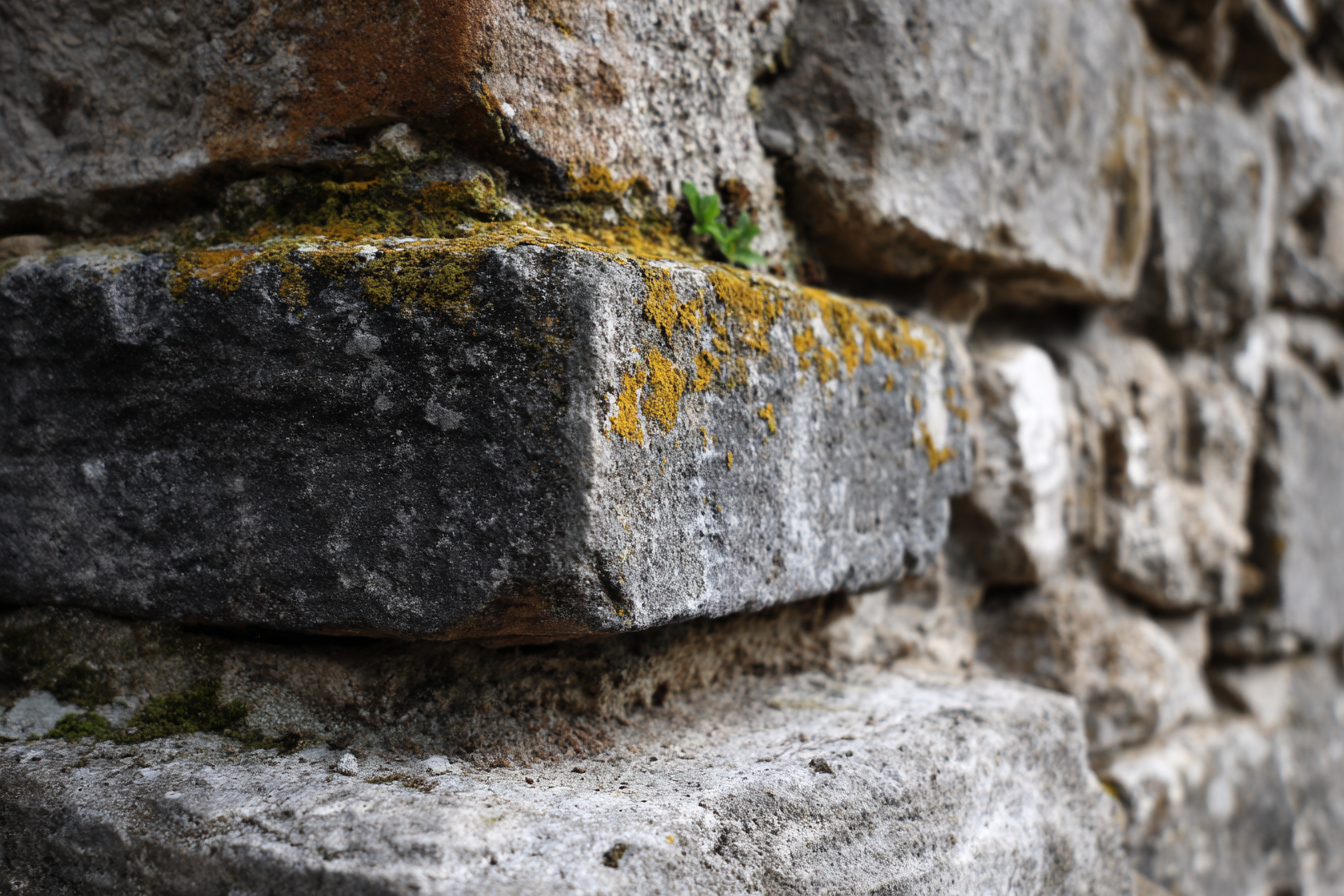
Stone masonry represents perhaps the most durable of vernacular building traditions. Structures built from locally quarried stone, set in lime-based mortar, frequently remain substantially intact after a thousand years or more. The stability derives from simple principles: large mass, good drainage, and properly formulated mortar that is softer than the stone itself—allowing it to fail in preference to the masonry units, a sacrifice that protects the structure as a whole.
The selection of stone mattered according to local geology: granite in granite-bearing regions, sandstone where available, limestone in chalk country. These materials were not interchangeable; each required different approaches to quarrying, shaping, and joinery. Builders developed techniques specific to the stone they worked with, and these techniques proved robust because they were adapted to the material at hand.
Lime mortar, made from locally burned limestone, created joints that set slowly, allowing for long working time and producing mortar that could accommodate slight movement without cracking. As this mortar aged, it reabsorbed CO₂ from the air, becoming harder and more durable. Repointing—the renewal of mortar joints—became a standard maintenance practice. A stone structure could be tended across indefinite time by selectively replacing mortar while the stone itself often required no intervention.
Material Knowledge as Adaptation
What distinguishes vernacular construction from improvised building is the depth of accumulated observation embedded in each tradition. The materials selected, the proportions used, the joinery and assembly methods—these represent solutions that were tested across generations and retained because they proved robust. A builder using traditional techniques was not relying on intuition but on inherited knowledge accumulated through centuries of observation and repair.
This knowledge was not recorded in manuals but held in practice. The mason understood lime mortar not through chemical theory but through the repeated observation of what worked: how fast it set, how it weathered, how long it lasted. The timber framer understood wood not through microscopic analysis but through generations of selecting trees, felling them at the right season, and observing how they performed across decades.
The structures these traditions produced are still standing. Across the world, buildings constructed eight hundred, nine hundred, or in some cases more than a thousand years ago remain occupied, remain tended, remain functional. They have weathered conquest, climate variation, earthquake, and centuries of continuous use. This persistence is not random. It is the result of material traditions adapted with precision to local conditions, refined through repeated practice, and sustained through patterns of maintenance that proved effective across time.
Continuity and Maintenance
The advantage of vernacular construction lies not only in durability but in maintainability. These buildings can be repaired using the same materials and methods that created them. Lime mortar can be made from available limestone. Stone can be quarried and shaped using traditional tools. Earth can be prepared from subsoil and straw. Timber can be selected and jointed according to traditional logic. The knowledge required to maintain these structures remains teachable and transmissible, uncoupled from industrial supply chains or proprietary systems.
As a building ages across centuries, its maintenance requirements are distributed across time rather than concentrated at any single moment. A stone building does not suddenly require replacement of its structure; rather, it requires periodic repointing, drainage maintenance, and attention to any localized damage. A timber frame requires inspection and localized repair of damaged members. An earthen structure requires periodic recoating of exterior surfaces. These are tasks that can be distributed across generations, requiring no sudden crisis of total renewal.
This distributed maintenance—spread across time, manageable in scale, requiring no specialized equipment or distant supply—represents perhaps the deepest sustainability of vernacular construction. The building remains habitable not through dramatic intervention but through continuous, attentive tending.