Hempcrete
Hempcrete is not concrete. The name suggests a kinship that does not exist. Concrete is a structural material — dense, rigid, compressive. Hempcrete is an insulating infill — light, porous, and incapable of bearing any load beyond its own weight. The confusion has consequences: buildings designed with hempcrete as structure will fail. Buildings designed with hempcrete as enclosure perform remarkably well.
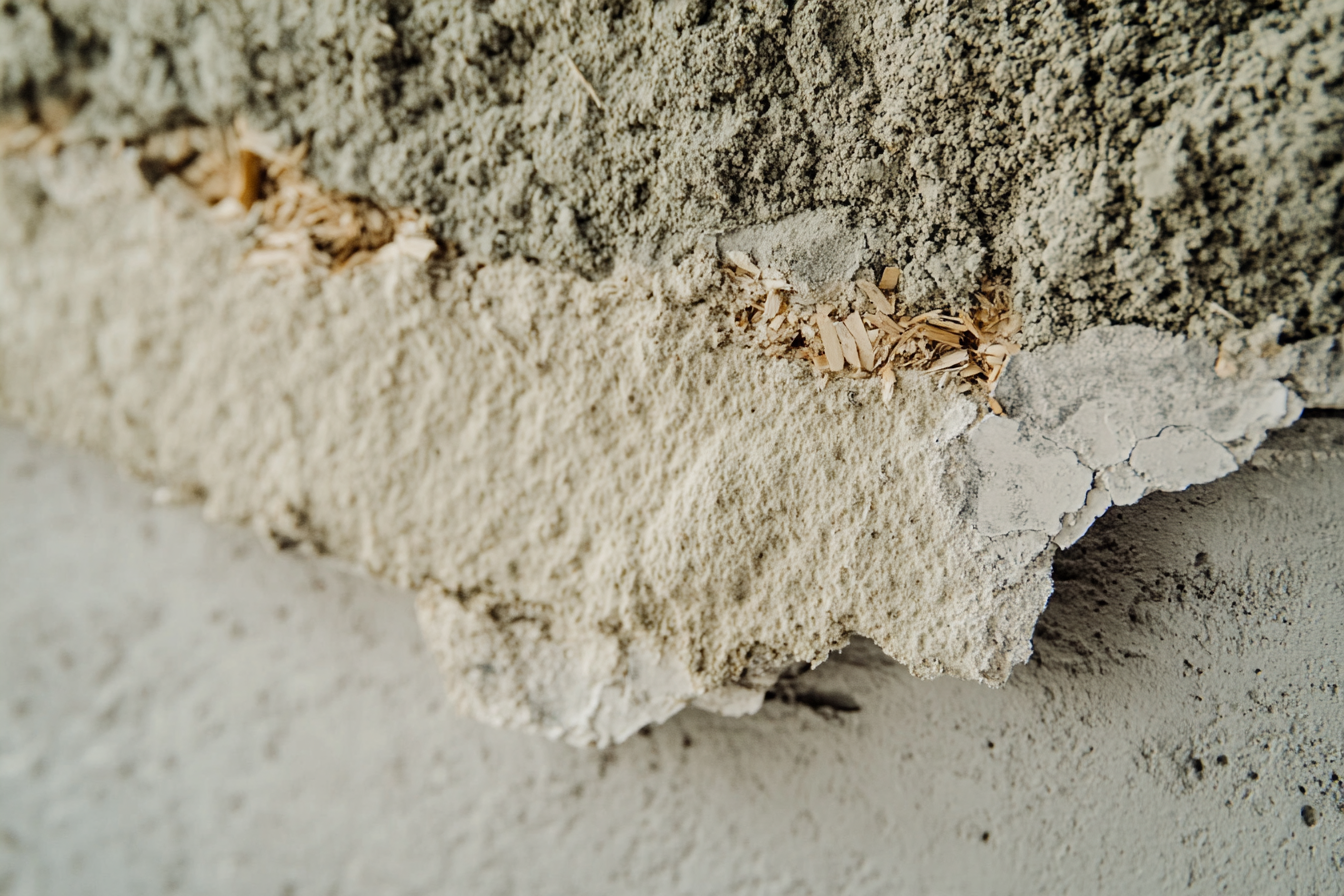
The material is a composite of hemp shiv — the woody inner core of the hemp stalk, chopped into fragments roughly 10 to 25 millimeters long — and a lime-based binder. The shiv provides the bulk and the insulating air spaces; the lime coats the particles, bonds them together, and creates the rigid matrix that gives the material its shape. The density of the finished product is typically 250 to 350 kilograms per cubic meter — roughly one-seventh the density of concrete. It is closer in weight to softwood timber than to any masite material, and it behaves accordingly: it insulates rather than stores heat, it absorbs rather than reflects sound, and it manages moisture rather than resisting it.
The mixing and placement are straightforward. Hemp shiv and lime binder are combined in a ratio of approximately three to four parts shiv to one part binder by volume, with water added to activate the lime. The mixture is packed into temporary formwork erected around a structural frame — typically timber — and tamped to a consistent density. After the formwork is removed, the hempcrete cures over several weeks as the lime carbonates, absorbing carbon dioxide from the air and converting from calcium hydroxide to calcium carbonate. The material hardens progressively, reaching working strength in four to eight weeks and continuing to gain hardness over months and years.
Chemistry of Curing
The curing of hempcrete involves two distinct chemical processes occurring simultaneously. The hemp shiv, composed of cellulose that absorbed carbon dioxide during the plant's four-month growing cycle, retains that carbon in the wall — locked in the cellular structure of the woody fibers. The lime binder, meanwhile, undergoes carbonation: calcium hydroxide reacts with atmospheric carbon dioxide and converts to calcium carbonate, hardening progressively as the reaction proceeds inward from the surface. This carbonation is the same process that hardens lime mortar and lime render — slow, air-dependent, and continuing for months or years after placement.
The chemical result is that both components of the wall — the biological matrix and the mineral binder — incorporate atmospheric carbon dioxide as they cure. The wall is, in a straightforward chemical sense, a repository of atmospheric carbon, held in stable mineral and organic form for as long as the wall stands. The quantity is approximately 35 to 50 kilograms per cubic meter — a measurable presence, though the more consequential observation is that the curing process itself is what produces the wall's hardness and durability. The carbon incorporation is not an incidental benefit but the mechanism by which the material achieves its final state.
Moisture and Breath
The most distinctive property of hempcrete in service is its hygroscopic behavior. The hemp shiv absorbs and releases moisture vapor in response to changes in relative humidity, buffering the interior environment against the rapid humidity swings that can cause condensation, mold growth, and material degradation. A hempcrete wall in a humid environment absorbs excess moisture into the shiv particles; when the humidity drops, it releases the moisture back into the air. This cycling occurs continuously, without any mechanical assistance, and the effect on interior humidity stability is measurable and significant.
The lime matrix contributes to this system by maintaining an alkaline environment — typically pH 11 to 12 — that is hostile to mold and bacterial growth. Even when the shiv is holding significant moisture, the alkalinity prevents biological colonization. This combination of moisture buffering and biological resistance produces a wall assembly that is remarkably tolerant of imperfect detailing — small leaks or condensation events that would cause rot or mold in a conventional wall are absorbed and redistributed without consequence, provided the wall can dry to at least one face.
The condition is important. Hempcrete must be able to dry. Both faces should be finished with vapor-permeable materials — lime render, earth plaster, lime paint — that allow moisture to migrate outward and evaporate. Applying a vapor-impermeable finish — cement render, vinyl paint, synthetic membranes — to either face traps moisture within the wall and defeats the mechanism that makes hempcrete work. The material requires breathability not as a preference but as an operating condition.
Thermal Performance
The thermal conductivity of hempcrete is approximately 0.06 to 0.09 watts per meter-kelvin, depending on density and moisture content. This places it in a middle range — better than concrete or masonry by a factor of ten, but less effective per unit thickness than mineral wool or rigid foam. A 300-millimeter hempcrete wall provides a thermal resistance of approximately R-15 to R-20 — adequate for many climates but below the levels specified by the most demanding energy standards.
What the conductivity figure does not capture is the material's thermal inertia — its capacity to absorb heat slowly and release it over time, smoothing the temperature cycle. Hempcrete occupies an unusual position between pure insulation and pure thermal mass. It is not dense enough to provide the significant thermal lag of rammed earth or concrete, nor light enough to provide the immediate resistance of mineral wool. It provides a moderate version of both, and in temperate climates with modest temperature swings, this combination produces a stable interior temperature with less energy input than either strategy alone.
Structure and Limits
Hempcrete carries no structural load. Its compressive strength — typically 0.3 to 1.0 megapascals — is sufficient to support its own weight in a wall but inadequate for any superimposed load. The structural system must be provided by the frame around which the hempcrete is cast: timber post-and-beam, timber stud, or in some cases steel. The hempcrete fills the spaces between the frame members, providing insulation, moisture management, and a substrate for plaster, while the frame carries all gravitational and lateral loads.
This dependency on a frame is sometimes seen as a limitation. It is more accurately understood as a clarification of roles. The hempcrete does the things it does well — insulating, buffering moisture, sequestering carbon — and delegates the things it cannot do to a material better suited. The frame provides the structure. The hempcrete provides the environment. Together, they produce a wall that is thermally effective, vapor-open, carbon-negative, and structurally sound, with each material contributing what it is able to and nothing it is not.