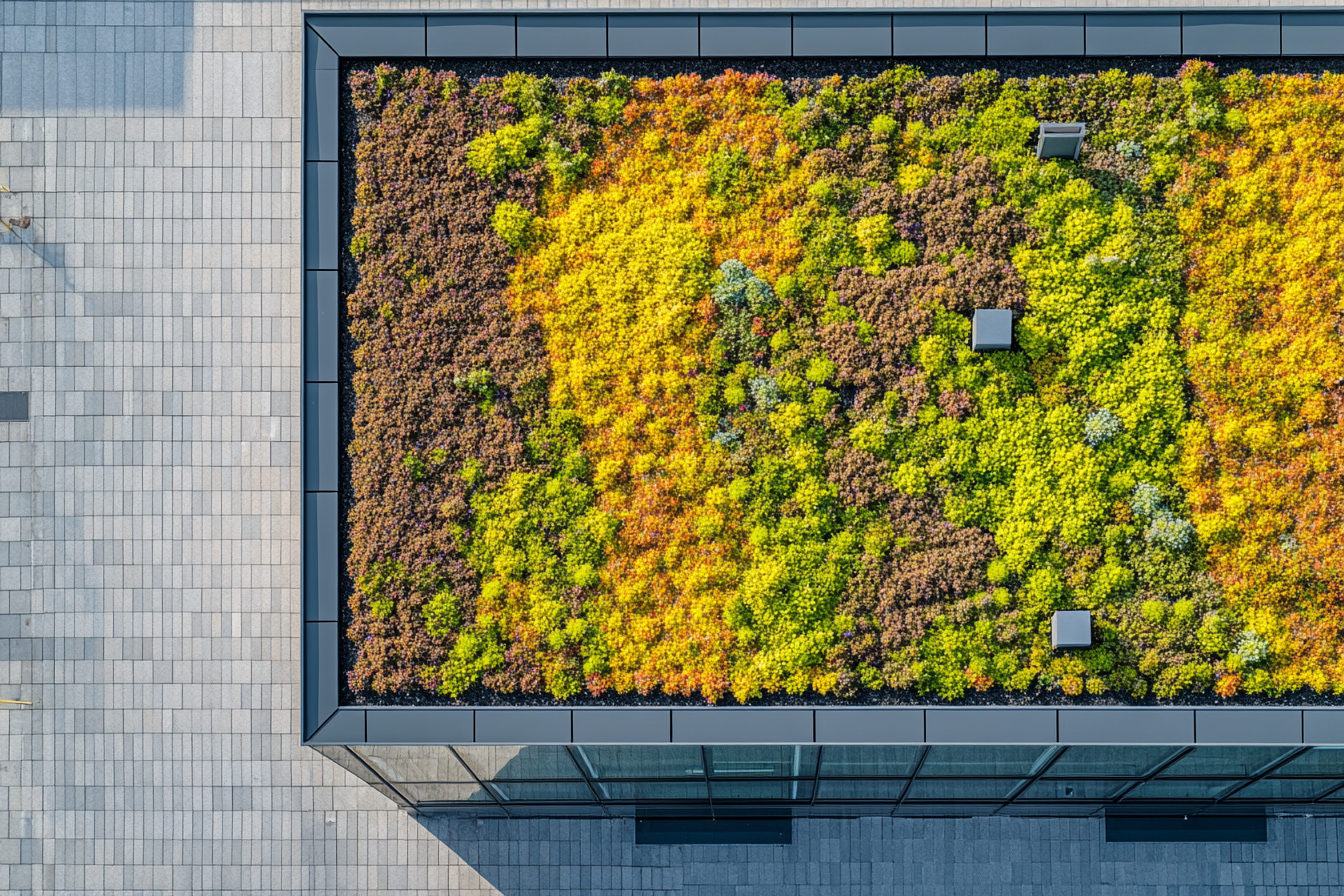
Living Roofs
A living roof is a roof that grows. Beneath the vegetation — the sedums, the grasses, the wildflowers that shift color through the seasons — is an engineered assembly of layers, each performing a specific function: waterproofing, root protection, drainage, moisture retention, and growing substrate. The plants are the visible surface. The assembly beneath them is what makes the surface possible.
The terminology distinguishes between extensive and intensive systems, and the distinction is primarily one of depth. An extensive living roof carries a substrate layer of 60 to 150 millimeters — shallow enough to support only drought-tolerant, low-growing species such as sedums, mosses, and certain grasses. An intensive living roof carries 150 to 1,000 millimeters or more of substrate, deep enough for perennials, shrubs, and in the deepest installations, small trees. The depth determines the weight, the plant palette, the irrigation demand, and the structural requirements of the roof below. Everything follows from how much soil — or rather, how much engineered growing medium — sits on top of the building.
The Assembly
The roof deck — concrete, steel, or timber — carries the load. Above it, a waterproofing membrane provides the primary weather barrier. This membrane is the true roof; everything above it is, structurally speaking, an addition. A root barrier — sometimes integral to the membrane, sometimes a separate sheet — prevents root penetration into the waterproof layer. Above the root barrier, a drainage layer allows excess water to flow laterally toward roof drains. This layer is typically a dimpled plastic sheet, a layer of lightweight expanded clay aggregate, or a geocomposite mat. A filter fabric above the drainage layer prevents fine substrate particles from washing down and clogging the drainage.
The growing substrate itself is not soil in the agricultural sense. It is an engineered medium — typically 70 to 80 percent mineral aggregate by volume, with the balance in organic matter. Expanded clay aggregate, expanded shale, pumice, and crushed brick are common mineral components, chosen for their low density, high porosity, and resistance to decomposition. The organic fraction provides initial nutrients and water-holding capacity. The total saturated weight of an extensive system ranges from 60 to 150 kilograms per square meter. An intensive system, fully saturated, may weigh 200 to 500 kilograms per square meter or more. These are significant structural loads, and any building intended to carry a living roof must account for them in the original design or be assessed for retrofit capacity.
Thermal Behavior
A living roof moderates the temperature of the roof surface through three mechanisms. The substrate provides thermal mass and insulation — even 100 millimeters of growing medium adds measurable resistance to heat transfer. The vegetation provides shading, preventing direct solar radiation from reaching the substrate surface. And evapotranspiration — the release of water vapor through the plants and from the substrate surface — provides active cooling, absorbing latent heat from the roof assembly as water changes phase from liquid to vapor.
The combined effect is substantial. A conventional dark roof surface may reach 70 to 80 degrees Celsius on a summer afternoon. The surface temperature of an extensive living roof under the same conditions rarely exceeds 30 to 35 degrees. This reduction in surface temperature decreases heat flux through the roof assembly, reducing the cooling demand of the building below. In winter, the substrate provides additional insulation, though the thermal resistance of a thin extensive system is modest — roughly equivalent to 20 to 40 millimeters of conventional insulation. The primary winter benefit is the reduction of heat loss through the roof membrane, which is shielded from wind and from the radiative cooling that draws heat from exposed surfaces on clear nights.
Water
A living roof retains rainfall. The substrate absorbs water, the plants take it up through their roots, and both substrate and vegetation release it gradually through evaporation and transpiration. An extensive system retains 40 to 60 percent of annual rainfall in temperate climates; an intensive system, with its deeper substrate, retains 60 to 90 percent. During individual storm events, the retention can be higher — a dry extensive substrate can absorb 20 to 40 millimeters of rainfall before any runoff occurs, and the delay between the start of rainfall and the start of runoff may be 30 minutes to several hours depending on intensity and antecedent moisture conditions.
This retention has consequences for the building and for what lies beyond it. The roof drains carry less water, less often. The stormwater infrastructure downstream receives a more gradual flow. The water that does leave the roof is partially filtered by the substrate, carrying lower concentrations of the particulates and dissolved pollutants that wash from conventional roof surfaces. None of this is incidental. The living roof is a hydrological system, and its water management is as much a function of the design as its botanical character.
What Grows
The plant selection for an extensive system is constrained by the substrate depth and the absence of irrigation. Sedum species dominate because they are succulent — they store water in their leaves and tolerate prolonged drought. Sedum album, Sedum acre, Sedum reflexum, and Sedum spurium are common in temperate installations, forming dense mats that cover the substrate surface within one to three growing seasons. Over time, if conditions permit, other species colonize the roof — mosses in shaded or moist areas, annual wildflowers from wind-blown seed, and occasionally grasses that establish in deeper pockets of accumulated organic matter. The roof develops a plant community that reflects its microclimate: aspect, exposure, substrate depth variation, and moisture patterns across the surface.
An intensive system allows deliberate planting of a broader palette — perennials, ornamental grasses, groundcovers, shrubs — but requires irrigation, deeper substrate, and periodic maintenance. The intensive roof is a garden, with the maintenance demands of a garden. The extensive roof is closer to a meadow: planted initially, then largely left to its own processes, tended only to remove woody volunteers that could compromise the membrane and to clear drainage outlets.
Maintenance and Duration
No living roof is maintenance-free. Extensive systems require a minimum of one to two inspections per year — clearing drains, removing invasive species, and checking the membrane at penetrations and edges where failure is most likely. Intensive systems require seasonal planting, pruning, irrigation management, and substrate replenishment as the organic fraction decomposes over time. The plants are self-sustaining in the sense that they grow without intervention. The assembly beneath them is not.
The membrane beneath a living roof is protected from ultraviolet radiation, from thermal cycling, and from mechanical abrasion — all of which degrade exposed roofing membranes. A conventional flat roof membrane may last 20 to 25 years before replacement. A membrane beneath a living roof, shielded by substrate and vegetation, may last 40 to 60 years. The living roof extends the life of the component it depends on most. In this respect, the relationship between the plants and the membrane is reciprocal: the membrane holds the water out; the plants hold the weather off the membrane. Each protects what the other requires.
What changes over time is the surface. The sedum mat thickens. Mosses appear. Wind-sown species establish and fade. The substrate consolidates and its organic content shifts. A living roof at twenty years looks different from the same roof at two — not degraded, but developed, in the way that any planted surface develops when it is left to negotiate with its conditions. The assembly beneath is stable. The surface is alive, and what is alive is never finished.