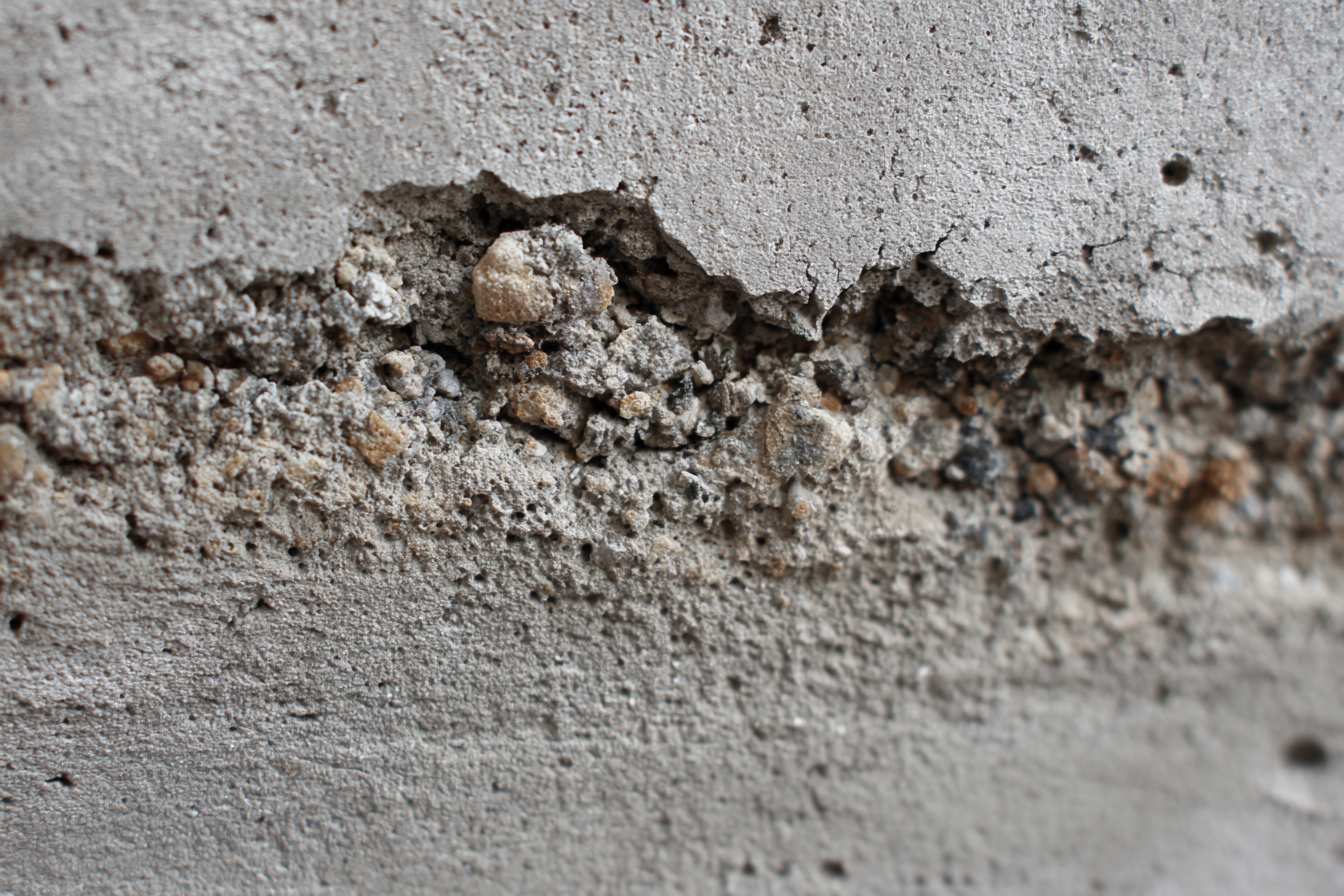
Concrete
Concrete is calcium silicate hydrate bound around aggregate — a chemical event, frozen in place. It begins as powder and water and gravel, and within hours it is something else entirely: a synthetic stone that will continue reacting, slowly, for decades.
The binder is Portland cement, produced by heating limestone and clay to approximately 1,450 degrees Celsius in a rotary kiln. The calcination drives off carbon dioxide from the calcium carbonate, and the resulting clinite fuses into nodules that are ground to a fine powder. This powder, when mixed with water, undergoes hydration — a series of exothermic reactions that produce calcium silicate hydrate, the crystalline gel that gives concrete its compressive strength. The process is irreversible. Once hydrated, cement cannot be returned to powder. The material has crossed a threshold.
The aggregate — sand, gravel, crushed stone — constitutes sixty to seventy-five percent of the volume and provides the structural skeleton. The cement paste fills the voids between aggregate particles, bonding them into a composite. The properties of the finished concrete depend on the ratio of water to cement, the grading and mineralogy of the aggregate, the curing conditions, and time. Always time.
The Carbon Question
Cement production accounts for roughly eight percent of global carbon dioxide emissions. The sources are twofold: the calcination of limestone releases CO₂ as a chemical byproduct, and the fuel burned to heat the kiln adds more. Of the two, calcination is the larger contributor and the harder to eliminate, because the carbon is locked in the raw material itself. No change in fuel source addresses it.
Supplementary cementitious materials reduce the proportion of Portland cement in the mix. Fly ash, a residue of coal combustion, reacts pozzolanically with the calcium hydroxide produced during hydration, forming additional binding compounds. Ground granulated blast-furnace slag behaves similarly. Silica fume, finer than cement by an order of magnitude, fills the spaces between cement grains and produces an exceptionally dense matrix. Each of these substitutes carries its own embodied energy and supply constraints, but in blended cements they can replace thirty to seventy percent of the Portland clinker, with corresponding reductions in the CO₂ profile of the binder.
The question is not whether concrete can be made with less carbon. It can. The question is whether the structures it forms justify the energy and emissions they embody — and whether they last long enough to amortize that cost over a meaningful span of time.
Behavior Over Time
Concrete gains strength for years after placement. The hydration reactions that begin in the first hours continue at a diminishing rate for decades, and in favorable conditions the compressive strength at fifty years may exceed the twenty-eight-day design strength by thirty to fifty percent. The material is not static. It is becoming.
Carbonation is the slow inward migration of atmospheric carbon dioxide through the pore structure of the concrete. The CO₂ reacts with calcium hydroxide in the cement paste, producing calcium carbonate — limestone, essentially, completing a chemical cycle that began in the kiln. Carbonation increases surface hardness and reduces permeability, but it also lowers the pH of the concrete, which over time can depassivate embedded steel reinforcement and initiate corrosion. The carbonation front advances at a rate determined by the concrete's porosity, moisture content, and atmospheric CO₂ concentration — typically a few millimeters per decade in dense, well-cured concrete.
Cracking is inherent. Concrete shrinks as it cures, and the restraint provided by reinforcement, formwork, or adjacent sections induces tensile stress that the material cannot resist. Controlled cracking — through joints, reinforcement spacing, and mix design — is not a failure but a design strategy. The cracks that matter are the ones that were not anticipated: thermal cracks from inadequate curing, structural cracks from overload, and the slow propagation of micro-cracks under sustained load, a phenomenon known as creep.
Surface and Finish
The surface of formed concrete records the formwork that shaped it. Board-formed concrete retains the grain of the lumber; steel forms produce a smooth, sometimes glassy face; fabric forms yield curved surfaces with a textile imprint. The surface is a negative of the mold, and it carries that record indefinitely.
Exposed concrete weathers according to its orientation and exposure. Vertical surfaces develop streaking patterns as rainwater finds preferred paths, carrying dissolved minerals and depositing them in lines that darken or lighten the surface. Horizontal surfaces accumulate biological growth — algae, lichen, moss — in patterns that follow moisture and shade. In sheltered areas, the original form finish may persist for decades; in exposed areas, the surface evolves into something the formwork never anticipated.
This weathering is not damage. It is the material responding to its conditions, and over time it produces surfaces of considerable complexity — layered, variegated, marked by the passage of seasons in ways that no applied finish can replicate.
Aggregate and Place
Because aggregate constitutes the majority of its volume, concrete is, in a meaningful sense, local. A concrete structure built with river gravel from a nearby floodplain is chemically and visually distinct from one built with crushed basalt from a volcanic quarry or coral aggregate from a coastal reef. The color, texture, and thermal properties of the finished concrete are determined in large part by what was available within economical transport distance of the site.
This locality is most visible in exposed aggregate finishes, where the surface cement paste is removed — by washing, acid etching, or abrasive blasting — to reveal the stone beneath. The result is a surface that belongs to its geography: warm sandstone tones in sedimentary regions, dark grays and blacks in volcanic areas, the pale glitter of quartz in granitic terrain. The concrete becomes a mosaic of its source material, bound in place by the chemistry of the cement.
Longevity
Unreinforced concrete, protected from freeze-thaw cycling and chemical attack, has no known upper limit on service life. Roman marine concrete, placed two thousand years ago in harbor structures along the Mediterranean coast, has not only survived but has continued to gain strength through a slow pozzolanic reaction between volcanic ash, lime, and seawater. The mineral aluminous tobermorite, which forms in these conditions, is more stable than the calcium silicate hydrate in modern Portland cement concrete.
Reinforced concrete is more constrained. The service life is ultimately governed by the corrosion of the embedded steel, which depends on the depth and quality of the concrete cover, the rate of carbonation or chloride ingress, and the moisture conditions. In favorable environments — dry, temperate, with adequate cover — reinforced concrete structures have performed well for over a century with minimal intervention. In aggressive environments — marine, de-iced, tropical — the same structures may require significant repair within thirty to fifty years.
The material's longevity, then, is not a fixed property but a function of design decisions, placement quality, and the conditions it encounters over its service life. Concrete does not simply endure. It endures in a particular way, in a particular place, and the evidence of that endurance is written on its surface given enough time and attention to read.