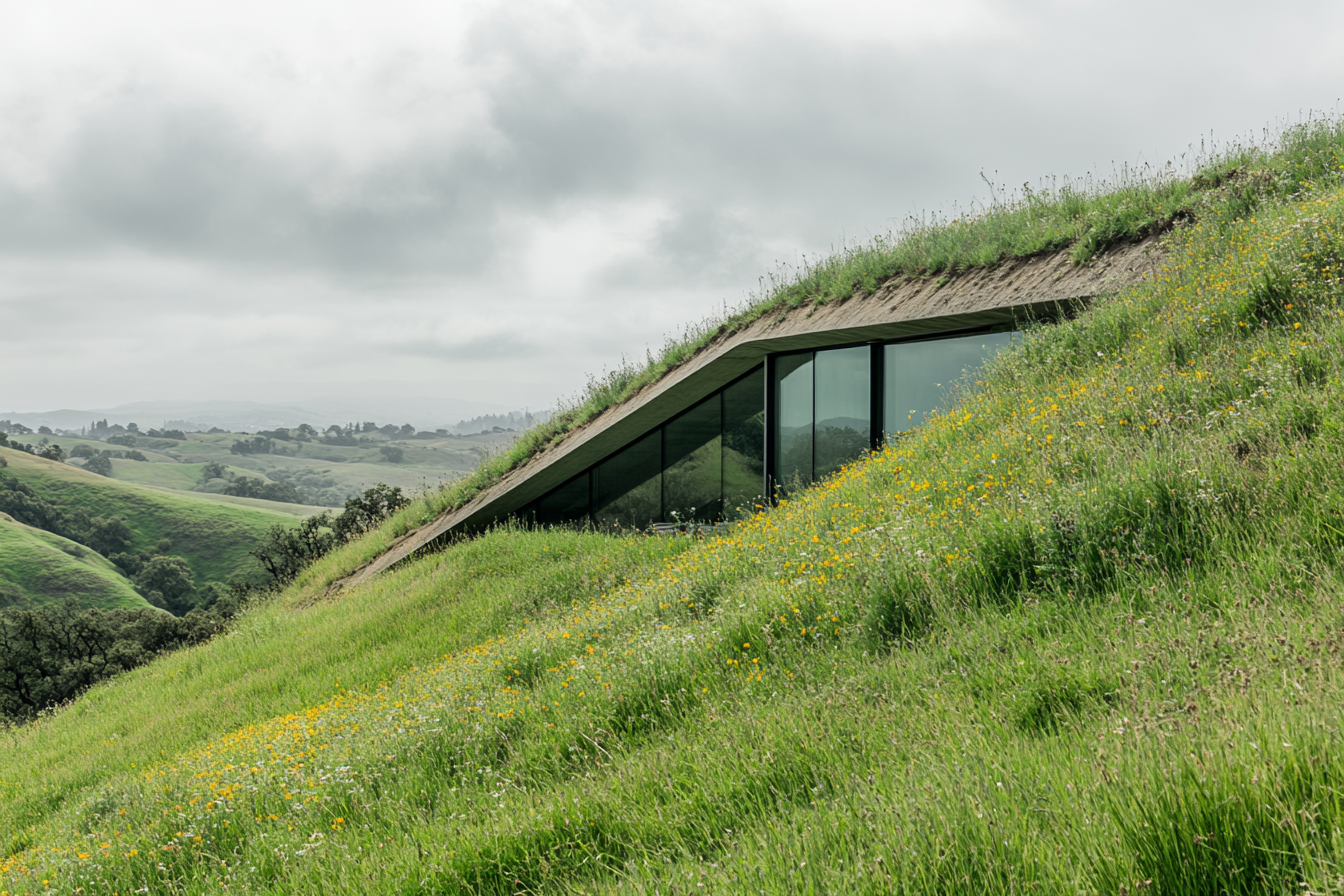
Earth Sheltering
Earth sheltering uses the ground itself as a thermal envelope. Unlike rammed earth or cob, where the earth is the structure, earth-sheltered construction places soil around or over a building made of other materials — concrete, masonry, timber — so that the ground's mass and stable temperature moderate what the interior experiences. The earth is not the wall. It is the insulation, the thermal mass, and the weather barrier, all at once.
The principle is straightforward. Below a depth of approximately 1.5 to 3 meters — depending on soil type and latitude — ground temperature is nearly constant year-round, varying by only a few degrees from the annual mean air temperature of the region. In temperate climates, this means the soil at depth holds steady at roughly 10 to 15 degrees Celsius regardless of whether the surface is frozen or baking. A building surrounded by that soil is surrounded by a medium that is always cooler than summer air and always warmer than winter air. The deeper the building sits, the more stable the envelope. The ground does not insulate quickly — soil has a thermal conductivity of approximately 0.5 to 2.0 watts per meter-kelvin, depending on moisture content — but it insulates massively, and its temperature is reliable in a way that air temperature never is.
Methods of Sheltering
The simplest form is berming: piling earth against the exterior walls of an above-grade structure. A bermed building sits at ground level or slightly above, with soil banked against its walls to a height that may reach the eaves. The exposed face — typically the south elevation in the northern hemisphere — remains open for light and ventilation, while the bermed faces gain the thermal stability of contact with the ground. Berming is the least disruptive method. It does not require excavation below grade, the structural loads are moderate, and existing buildings can sometimes be retrofitted with berms if the foundation and wall construction can support the lateral pressure.
Fully underground construction — where the building is excavated into the earth and the roof is at or below grade — provides the most complete thermal sheltering. The entire envelope is surrounded by soil at a stable temperature, and the building is effectively invisible from the surface. The structural demands are considerably greater. Earth weighs between 1,600 and 2,000 kilograms per cubic meter, and a roof carrying 600 millimeters of soil must support 960 to 1,200 kilograms per square meter of dead load before accounting for live loads or the weight of saturated soil after rainfall. Reinforced concrete is the typical structural material for underground construction, and the engineering is closer to tunnel or basement design than to conventional above-grade building.
Earth-covered roofs occupy the middle ground. The walls may be conventional, but the roof is designed to carry a layer of soil — typically 150 to 600 millimeters — that provides insulation, thermal mass, and stormwater absorption. The structural requirements are less than full underground construction but greater than a conventional roof. The weight of the soil, the waterproofing system, and the drainage layer must all be accounted for in the roof's structural design.
The Membrane
Every earth-sheltered structure depends on a waterproofing membrane between the building and the soil. The earth provides thermal performance. The membrane provides weather performance. If the membrane fails, the building floods — and unlike a conventional roof leak, which announces itself quickly with visible water, a membrane failure below grade can go undetected for months, with moisture migrating slowly through the structure before any sign reaches the interior.
The membrane materials are the same as those used in below-grade waterproofing generally: bituminous sheet membranes, liquid-applied elastomeric coatings, bentonite clay panels, and — in more recent construction — high-density polyethylene or thermoplastic polyolefin sheets. Each has different service life expectations, flexibility, and tolerance for substrate movement. Bentonite panels self-heal small punctures through the swelling of the clay when wetted. Bituminous membranes are proven over decades of use but are vulnerable to root penetration and require protection boards. Liquid-applied membranes conform to irregular surfaces but depend entirely on the skill of application for their continuity.
The membrane is the most critical and least visible component of the system. It cannot be inspected once the earth is in place. It cannot be repaired without excavation. Its service life — typically estimated at 30 to 50 years for most products — is shorter than the expected life of the building it protects. This is the central maintenance reality of earth sheltering: the ground is permanent, the building can be permanent, but the thin layer between them is not.
Light and Air
The challenge of earth sheltering is not thermal — the thermal performance is inherent in the method. The challenge is providing the light and ventilation that the earth excludes. A fully bermed or underground building receives no daylight on its sheltered faces. Light must be introduced deliberately: through the exposed south face, through courtyards cut into the earth, through light wells and clerestories that penetrate the soil cover, or through earth tubes that channel light below grade.
Ventilation follows similar constraints. Natural cross-ventilation requires at least two openings at different pressures, and a buried building may have only one exposed face. Earth tubes — buried pipes that draw exterior air through the soil before it enters the building — serve a dual function, pre-conditioning the air to near ground temperature while providing ventilation. Incoming air at 35 degrees Celsius in summer passes through a tube surrounded by soil at 13 degrees and arrives at the building at approximately 18 to 22 degrees, depending on tube length, diameter, and air velocity. The same system works in reverse in winter, warming frigid exterior air before it enters the building. The energy savings are considerable, but the system requires careful design to prevent condensation within the tubes and to ensure adequate air volume.
What Endures
The ground around an earth-sheltered building does not fail. It does not weather, corrode, or degrade. It settles, and once settled, it remains. The building within the ground — if structurally sound and properly drained — can persist for centuries. Roman cisterns, Cappadocian cave dwellings, and the underground granaries of the Sahel have survived millennia, not because their builders used exceptional materials, but because the earth around them provided a stable, moderate environment that placed minimal stress on the structure within.
The modern earth-sheltered building inherits this durability with one qualification: the waterproofing membrane has a finite service life. A building designed for earth sheltering must account for membrane replacement — or, more precisely, must be designed so that membrane failure does not become structural failure. Robust drainage systems, redundant waterproofing layers, and interior drainage channels that capture and redirect water before it causes damage are the mechanisms by which earth-sheltered buildings outlast their membranes. The ground will do its work indefinitely. The question is whether the interface between ground and building has been designed to be maintained across the same timescale.