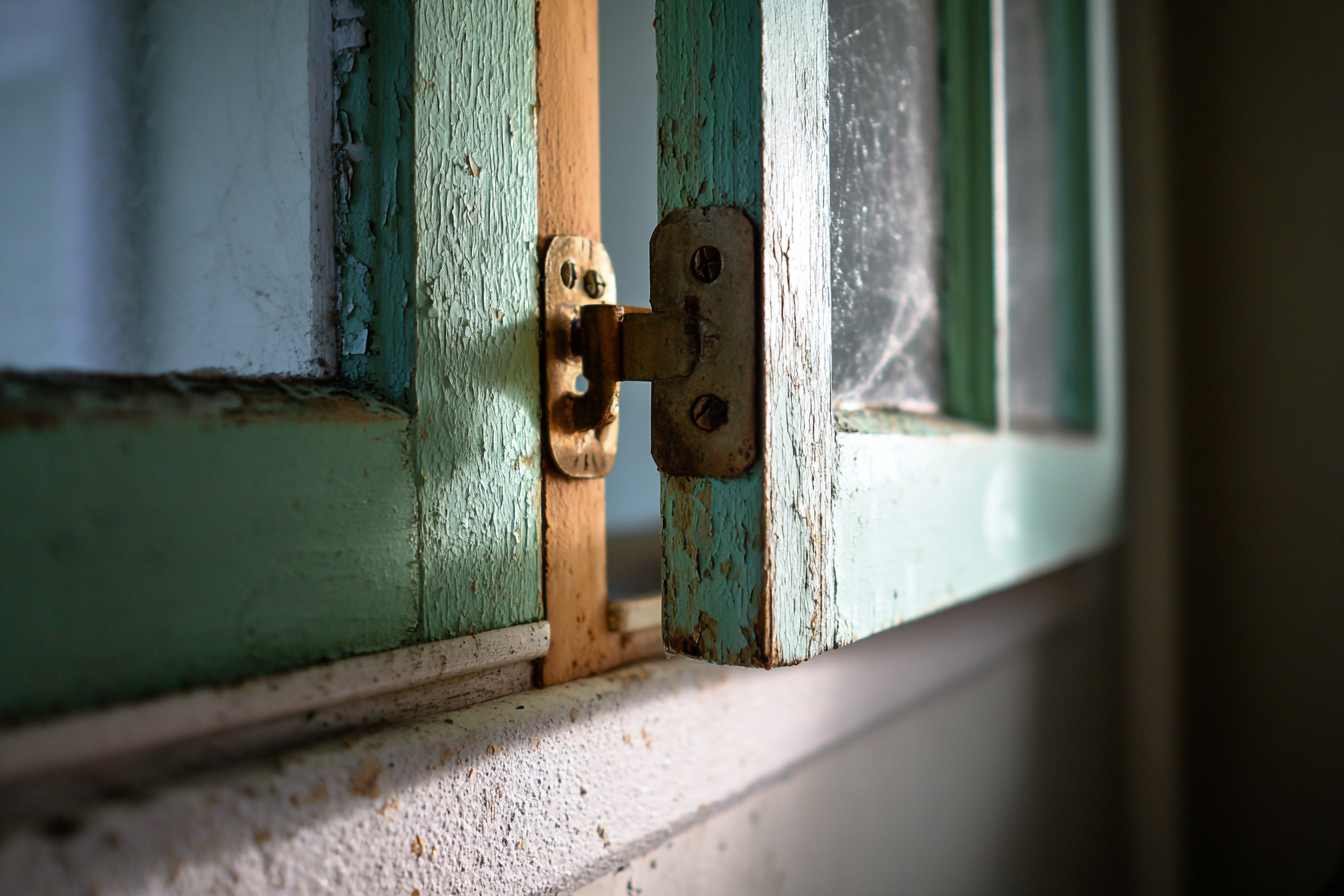
Ventilation
A building that breathes well announces itself immediately. The air tastes different. Not sterile, but clean. The surfaces stay dry. There is no stale corner, no dead hallway where moisture collects and stain blooms. The distinction between such a building and one that does not breathe well is unmistakable, and it outlasts nearly every other design decision made at the start.
The weight of still air
Still air becomes its own problem. It gathers moisture from the interior—evaporation, condensation, the slow release of water from materials and processes within—and has nowhere to go. The air cools against exterior walls, and the invisible water vapor becomes visible. Condensation forms on windows first. Then, in places where air barely moves, on surfaces deeper in the wall assembly. This is where mold establishes itself. Not as an inconvenience, but as a slow colonization of the building's structure. The presence of still air is the presence of decay accelerating at a pace that no paint or sealant can arrest.
A building that moves air, by contrast, simply releases the water back to the atmosphere. The surfaces stay dry. The interior spaces maintain a consistency that permits the structure to remain stable. This is not about air quality alone, though the sense of freshness is real and observable. It is about the building lasting. About the materials inside—wood, plaster, mortar—being kept in the condition they entered the space. The opening in the wall, strategically placed, becomes one of the most durable and resilient decisions in the building's design.
Warm air rising
The stack effect is observable before it is understood. In a building with a stairwell that rises through multiple stories, there is a particular warmth at the top. Warm air from below has risen without obstruction, and at the highest point, at the open window or ventilation opening, it exits. This rising is not subtle. It is powerful enough to create pressure, to draw cool air in at the lowest level, to establish a complete circuit of movement that asks nothing of electricity or mechanical intervention.
The vertical dimension of the building becomes active. What appears to be merely a passage through space is actually a channel for invisible forces. The height between the lowest occupied level and the highest opening determines the strength of this effect. Tall buildings use this principle with particular advantage. A stairwell becomes a thermal engine, running on the simple difference between warm interior air and cooler exterior conditions. This effect strengthens in winter, when temperature differences are greatest. In summer, the mechanism remains available but requires more attention to the direction of other forces—wind, in particular—to ensure the desired direction of flow.
The stack effect is most powerful when the openings are thoughtfully placed. Cool air should enter where it is drawn in most readily, usually at lower levels on the windward side. Warm air should exit where pressure is highest, usually at the top of the stack, on the leeward side or through roof openings. The building becomes a thermodynamic system, and the design decision is simply to acknowledge this and place openings accordingly.
The placement of windows
Every opening is a permanent decision. Unlike mechanical systems that can be replaced, upgraded, or removed entirely, the hole in the wall remains. The placement of that hole is essentially fixed. This imparts a particular weight to the question of where windows should be located and on which faces of the building.
Cross-ventilation occurs when openings exist on opposite sides of a space, or on different floors, allowing wind-driven flow. The effect is seasonal and directional. Prevailing winds will dominate in most places, arriving from particular directions more frequently and with more force. An opening aligned with the prevailing wind will draw air through the building with minimal effort. An opening on the opposite face will create the low-pressure zone toward which the wind wishes to push that air. The breeze that results is not incidental. It is the building's primary cooling mechanism on warm days when the stack effect works against opening the lowest levels.
But prevailing winds change direction across seasons. A location that catches fresh cool air in spring may face heating challenges in winter when that same wind arrives as bitter cold. The depth of the overhang, the presence of adjacent vegetation, and the building's position relative to terrain all modify the effect of wind. The window remains in its fixed location, but its role shifts across the calendar. A building that acknowledges this embeds flexibility into its design—spaces can be closed off, alternative routes for air can be selected, openings can be managed with care through the seasons.
The relationship between ventilation and aspect also matters. A building with long exposures on the windward and leeward sides can establish cross-ventilation effectively. A building that is deep and narrow along the wind direction will struggle with it. The width of rooms, the depth of the plan, and the size of openings all create friction or ease in this flow. These decisions, made early in the design phase, become essentially permanent once the walls are built.
Moisture and the invisible rhythm
The presence or absence of air movement determines whether moisture accumulates or disperses. This is observable at a granular level. Corner walls in bathrooms, where still air persists, are precisely where staining appears. Exterior walls with poor air circulation across their interior surface develop cold spots where condensation forms. The opposite is equally observable: spaces where air moves steadily maintain clear surfaces and dry conditions indefinitely.
Night ventilation is a practice that acknowledges the mass of the building as a thermal sink. On warm days, thermal mass—concrete floors, brick walls, stone—absorbs heat. At night, when outdoor air becomes cool, that mass can be cooled by opening the building fully. The cool air moves through the spaces, the heavy materials absorb the coolness, and the following day the building starts at a lower temperature baseline. As days warm and the stack effect strengthens, this coolness is released back into the spaces, moderating temperature swings. This practice requires opening the building at a moment when many would seal it against the night. But the result—a more moderate interior climate without mechanical intervention—demonstrates the durability of working with natural forces rather than against them.
The movement of air also regulates humidity at scales that static dehumidification cannot match. Ventilation is continuous and responsive. It does not require electrical input. A building that vents air through thoughtful openings will naturally shed excess moisture faster than it can accumulate, maintaining a kind of equilibrium that permits the structure itself to remain dry and intact.
What remains after systems fail
Mechanical ventilation systems fail. The components wear, the filters clog, the electrical systems age and become difficult to source or repair. The ductwork accumulates dust and sometimes becomes a route for contaminants. The system, once relied upon, becomes an object of frustration and expense. But the opening in the wall does not fail. The window frame, if built of durable material, will outlast the mechanical system by decades. The principle of stack effect does not depend on equipment. It will function as long as there is a temperature difference and an opening.
A building designed to breathe naturally carries within it the capacity to function well across a very long span of time. The decision to place openings thoughtfully, to allow stack effect to establish circulation, to permit cross-ventilation where wind offers assistance—these decisions compound across seasons and years. The building that was thoughtfully ventilated in its design phase will continue to ventilate itself with reliability that no mechanical system can provide. This is the measure of durability in this dimension. Not the absence of need, but the alignment of design with natural forces that ask nothing of maintenance and fail only when the building itself fails.