Material Cycles
The question of whether a material can return to its starting state—whether a substance can complete a full circle and begin again—distinguishes materials that decay from materials that endure, and those that can be reformed from those permanently transformed. The material itself determines this possibility. Time and separation determine whether the potential can be realized.
The Path of Decomposition
Some materials contain within themselves the capacity to return to the earth from which they came. Timber decomposes through the action of moisture, temperature, and microbial life, gradually breaking down into its constituent compounds. The carbon that once built the structure of a tree returns to soil and atmosphere over decades. Thatch made from straw or reed follows a similar trajectory—the plant material loses its coherence, softens, crumbles, and becomes indistinguishable from dirt within a lifetime or two. These materials complete a biological cycle that predates construction. They participate in the same processes that govern forests and grasslands.
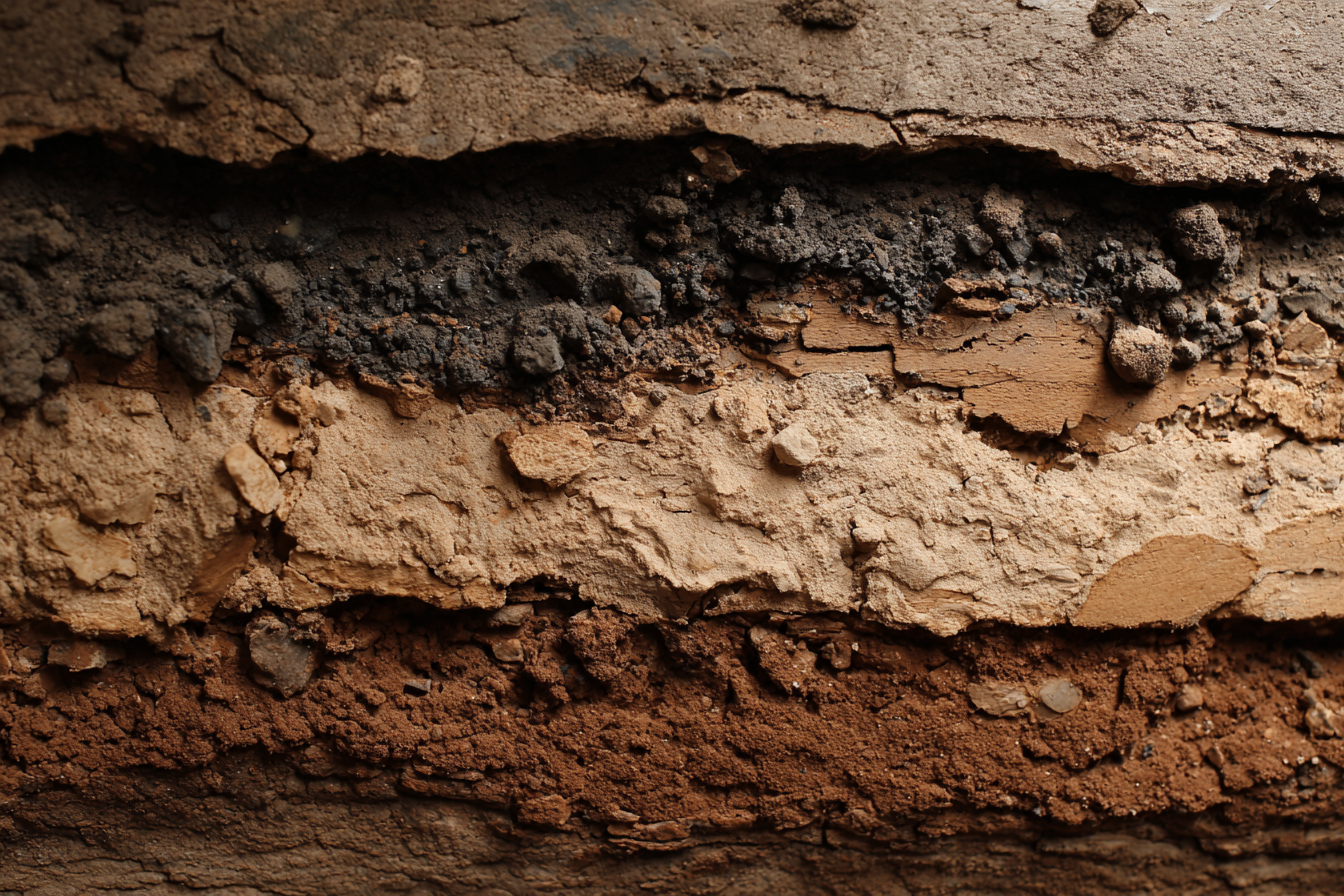
Earth materials—clay, adobe, rammed earth, unfired brick—revert to dust and clay slip under conditions of wetness and time. A wall built from earth can dissolve back into earth. Natural fibers spun into textiles or rope decompose through similar microbial processes. Cork, thatch, hemp—all move through phases of decay and eventual disappearance. The timescale varies: a hemp rope may vanish within years; a timber beam within decades or centuries depending on exposure and environment. But the trajectory is singular. There is no recovery phase, no reformation into building material again. Decomposition is irreversible.
The Reformation of Metals
Metals present a different category. Copper, aluminum, iron, lead—these materials can be heated to their melting point and cast again into new forms without fundamental change to their chemical identity. A copper pipe becomes molten copper which becomes a copper sheet, which becomes a copper fitting. No degradation accompanies this transformation as long as contamination does not intervene. A kilogram of copper recovered from a building contains the same material properties as a kilogram freshly extracted from ore.
The barrier to continuous cycling is not material degradation but rather separation. A copper water line fused to brass fittings cannot separate into pure copper again without technological intervention. When metals mix—when copper contains tin, when iron contains carbon or manganese—the resulting alloy cannot be simply unmixed. The alloy is now the material. A steel beam contains iron and carbon and other elements in specific proportions. Melting and recasting preserves the steel, but the steel cannot revert to pure iron and pure carbon. It is trapped in its composition.
Purity determines cycling possibility. As metals circulate through buildings and disassembly, they accumulate trace contaminants. Tiny quantities of lead in brass, copper in aluminum, nickel in stainless steel—each cycle can introduce new elements and narrow the metal's future applications. Eventually, a contaminated metal becomes suitable only for low-grade uses where such impurities matter less. The material still cycles, but its value and versatility narrow with each generation.
The Opacity of Glass
Glass occupies its own category. Like metals, glass melts and reforms without chemical transformation. A window pane melted down and recast becomes a new window pane in principle. The silica that forms glass remains silica through the process. Yet glass in buildings rarely circulates this way. Window frames contain rubber seals, metal frames, adhesives. These cannot accompany the glass into the furnace. Separation is labor-intensive. Mixed colors of glass cannot be remelted together—they become cloudy and unsuitable for clear applications. Tempered glass, once broken, cannot be recovered for remelting; the heat treatment is destroyed.
Glass demonstrates that material property alone does not determine cycling. The context in which the material exists—its attachments, its treatments, its integration into assemblies—often prevents the theoretical cycle from occurring. A perfectly cyclable material can be made practically uncyclable through design.
The Permanence of Combination
Composite materials—combinations of fibers and resins bonded together—represent a category with no clear cycle. Fiberglass cannot separate back into glass fibers and liquid resin. The bond is permanent. The material can be ground into smaller pieces, but these fragments are not fiber nor resin; they are composite fragments. They might be used as filler in new composites, but they introduce weakness. Each new composite incorporating recycled content contains less strength and less predictability than virgin material. The cycle, if it exists at all, is a downward spiral toward eventual disposal.
Concrete demonstrates the same trap. Portland cement binds aggregate together in a chemical transformation. The cement hydrates and hardens—a one-way process. Crushing concrete produces aggregate that can be reused in new concrete, but the original cement's properties are lost. The aggregate returns, but not the binder. Recycled aggregate concrete is weaker than virgin concrete. The cycle exists but with diminishing returns.
Mixed materials and irreversible chemical bonds define materials that do not cycle. A vinyl composite floor cannot return to vinyl and composite parts. An insulation foam cannot return to its component chemicals. An asphalt shingle cannot separate back into asphalt and felt. The material is locked into its current form by the chemistry of its creation.
The Infrastructure of Separation
Even materials with theoretical cycling potential require one additional condition: the ability to be separated from their context. A copper water line installed within a concrete wall cannot cycle—not because copper cannot reform, but because extraction would require destroying the wall. A timber beam bolted to steel requires labor to unbolt before the timber and steel can follow separate paths. A floor made of multiple materials bonded together can only cycle if the bonds can be severed and the materials separated at end of life.
This separation is not automatic. It requires intentional design—bolted connections rather than welded, mechanical fasteners rather than adhesives, distinct material layers that can be peeled apart rather than fused together. Most buildings do not anticipate disassembly. Materials are installed to remain in place for the life of the structure and beyond. When renovation or demolition occurs, the materials are often destroyed together, their separate cycling potentials unrealized.
The true cycling of a material requires three conditions: the material itself must be chemically stable through reformation, it must be separated from contaminants and incompatible materials, and it must be physically separated from its assemblies when cycling begins. Rarely are all three conditions met simultaneously. A material may be perfectly capable of cycling in theory, yet uncyclable in reality due to its installation, its context, or the absence of infrastructure to manage its recovery.
The Horizon of Time
The cycles that do occur operate across vastly different timescales. Decomposition of timber might span fifty years or five hundred years depending on moisture and environment. The reformation of metals through melting occurs within months if recovery systems are in place, or never if materials remain dispersed in landfills. The potential cycle is defined not only by material properties but by the practical systems that exist to realize it, and those systems change across generations.
A material installed today might be perfectly cyclable in a future where recovery infrastructure exists, or perfectly uncyclable in a future where conditions have shifted away from recovery. The same copper wire has different cycling prospects in different eras. The possibility lives in the material itself—held open by its chemical properties—but actualized or prevented by circumstances beyond the material's existence.
Understanding material cycles requires this dual vision: recognizing both what the material itself can sustain, and what the world around it is prepared to do. The distinction between biological return to earth and technical reformation through melting is material truth. The distinction between potential cycling and actual cycling is the truth of how buildings exist in time.