Material Toxicology
When a building is sealed and closed, its interior air becomes a chemical inventory of every surface. The atmosphere inside exists in constant exchange with the materials that bound it—not through decay or visible degradation, but through the invisible migration of molecular compounds released from paints, adhesives, boards, and finishes. This is the chemistry of enclosure: what materials emit, what remains bound, what accumulates over weeks and years.
The Volatile Release
Certain compounds within building materials exist in a state between solid and vapor. These volatile organic compounds—VOCs—have low boiling points and partial pressures that allow them to escape from their parent material and enter the air. The process begins immediately after a material is installed or exposed. A freshly applied paint releases solvents in greatest concentration in the first hours and days; the smell of new carpet is formaldehyde and other emissions rising from adhesives and backing materials. This initial burst is not random. It follows a curve of diminishing intensity, with the most rapid release occurring at the start, then tapering over weeks or months, though some materials continue to emit in measurable quantities for years.
The rate of off-gassing depends on temperature, air circulation, and the material's own composition. Warm air accelerates the process; still air allows compounds to accumulate in corners and enclosures. A basement with stable temperature and low air exchange will off-gas more slowly than an attic where temperature fluctuates daily. The chemistry is deterministic: materials release what their composition allows, independent of observation or intention.
Formaldehyde and Resin Compounds
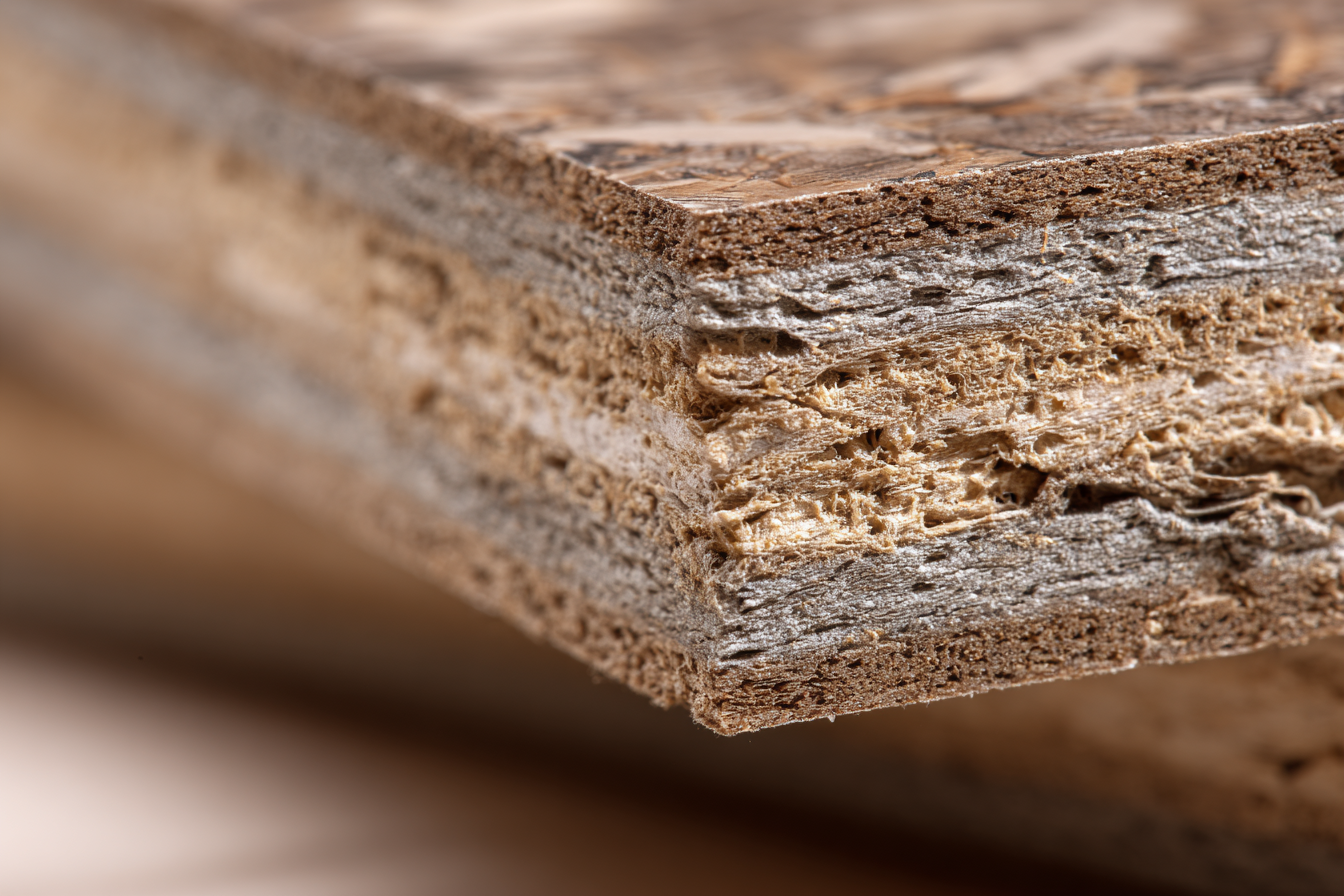
Plywood, medium-density fiberboard, and particle board are bound with urea-formaldehyde or phenol-formaldehyde resins. These resins are structural—they hold the wood particles or veneers together—but they are also inherently unstable, prone to hydrolyze when exposed to moisture and warmth. When they break down, they release formaldehyde gas. This release is not a fixed quantity. It continues over the life of the material, intensifying in humid conditions and at elevated temperatures, diminishing in dry air. A board installed in a cool, dry space will emit slowly; the same board in a humid climate will release formaldehyde more rapidly.
The chemistry of these resins reveals why some older materials pose different problems than modern ones. Early plywood used phenol-formaldehyde, which is chemically more stable but still capable of slow release. Modern boards often use urea-formaldehyde, which is cheaper but degrades more readily in the presence of moisture. The invisible history of material science lives in the off-gassing rate of a sheet of plywood.
Encapsulation and Disturbance
Heavy metals present a different chemical problem. Lead in old paint, chromium in treated timber, cadmium in certain pigments—these elements are stable when bound within a matrix, when the paint layer is intact or the wood is sealed. The chemistry of encapsulation is straightforward: the metal atoms are locked in a compound or dispersed within a solid medium, unable to migrate to air as vapor. But encapsulation is fragile. When paint chalks or peels, when treated wood is cut or sanded, when the barrier is breached, the metal compounds become available. They do not vaporize like VOCs; instead, they become suspended as dust or abraded particles that can be distributed throughout the enclosed space.
Asbestos represents an extreme version of this chemistry. The mineral fibers are chemically inert—they will not degrade or release compounds into air. But mechanical action can separate fibers from their matrix. When asbestos-containing insulation is disturbed, when pipe lagging is cut, when tiles are broken, the fibers become airborne, drifting through the enclosed space according to air currents and gravity. The material itself is not reactive; the consequence is in its fibrous form suspended in air.
Migration and Accumulation
Some compounds do not vaporize but instead migrate slowly through materials and into the air. Plasticizers in PVC—phthalates added to make the plastic flexible—leach out over time. Flame retardants in foam insulation and synthetic textiles gradually separate from their matrices and become dust or vapor. These are not dramatic releases but slow migrations, molecules working their way out of the material structure through diffusion and absorption into surrounding air.
The rate of migration is determined by temperature, air humidity, and the polarity of the compounds involved. A plasticized PVC pipe in a warm, humid space will lose plasticizer faster than one in a cold, dry enclosure. The air in contact with the material becomes saturated with these migrating compounds; air that circulates away carries them into the broader interior atmosphere. Over months and years, the material gradually depletes its migrating compounds while the air accumulates them.
The Inert Alternatives
Stone contributes nothing to the air. Granite, limestone, marble, and slate are mineralogically stable; their constituent elements remain bound in crystalline structures. The chemistry is ancient and unchanging. Similarly, fired clay—brick, tile, terra cotta—is chemically inert. The clay has been heated to temperatures that drive off volatile compounds; what remains is a stable mineral matrix that will not emit or migrate anything into the atmosphere of the structure it encloses.
Glass, whether soda-lime from windows or borosilicate laboratory glass, is amorphous but chemically stable. Lime plaster, properly made and cured, converts to calcium carbonate and remains stable indefinitely. Untreated timber, if kept dry, releases nothing harmful to the air. These materials exist in a different chemistry than the composites and polymer-based products that dominate modern construction. Their simplicity—materials composed of single or closely related minerals, bound by simple chemistry—means they have nothing volatile to release, nothing toxic to migrate. They are inert not by virtue of absence but by composition.
The distinction is material and chemical. A structure built of stone, fired clay, glass, untreated timber, and lime plaster will have air that reflects only the normal composition of atmosphere—oxygen, nitrogen, trace gases—plus the minor off-gassing of any modern systems sealed within it. A structure built of plywood, particle board, polymer-based adhesives, synthetic paints, PVC, polyurethane foam, and treated finishes will have interior air significantly different from outside air, enriched with the compounds those materials emit and migrate. The composition of indoor air is an inventory of the materials that define it.